10 Healthy Breakfast Ideas for Bodybuilders (High Protein)
Home ›Supplements and Nutrition
If you’ve ever searched “what should I eat before the gym?” and landed on answers like: boiled egg, Oikos Pro yogurt drink, and a banana — you’re not wrong. But you’re also missing a system.
Without a phase-matched breakfast plan, you’re guessing your way through one of the most important meals of your day. That guesswork costs you muscle, energy, and progress — especially when your goal keeps shifting between a clean bulk (eating in a caloric surplus using primarily whole foods to maximize muscle growth) and a cutting phase (eating in a caloric deficit to reduce body fat while preserving muscle).
In this guide, you’ll find 25 complete healthy breakfast ideas for bodybuilders — organized by your exact goal — with precise macro targets so you stop guessing and start growing. We’ll cover the foundational rules first, then move through cold, hot, and batch-prep recipes before tackling specialized breakfasts for cholesterol, diabetes, and GLP-1 users.
Bodybuilders need 30–50g of quality protein at breakfast to shift the body into an anabolic state (when your body is actively building muscle) and support muscle repair — and matching your breakfast to your phase matters as much as the food itself. This is the core of The Phase-First Protocol.
- The Phase-First Protocol: Choose your breakfast category (Bulking, Cutting, or Health-Specific) before picking any single recipe
- Top beginner pick: “Proats” (protein-boosted overnight oats) — 40g protein, 5-minute prep, no cooking required
- Bulking phase: Target 600–800 kcal with complex carbs, whole eggs, and healthy fats
- Cutting phase: Lean proteins + high-fiber carbs, 350–450 kcal
- Conditions covered: Section 5 addresses cholesterol, diabetes, and GLP-1 medication adaptations with RD-reviewed guidance
Morning Macro Fundamentals & the 30-30-30 Rule
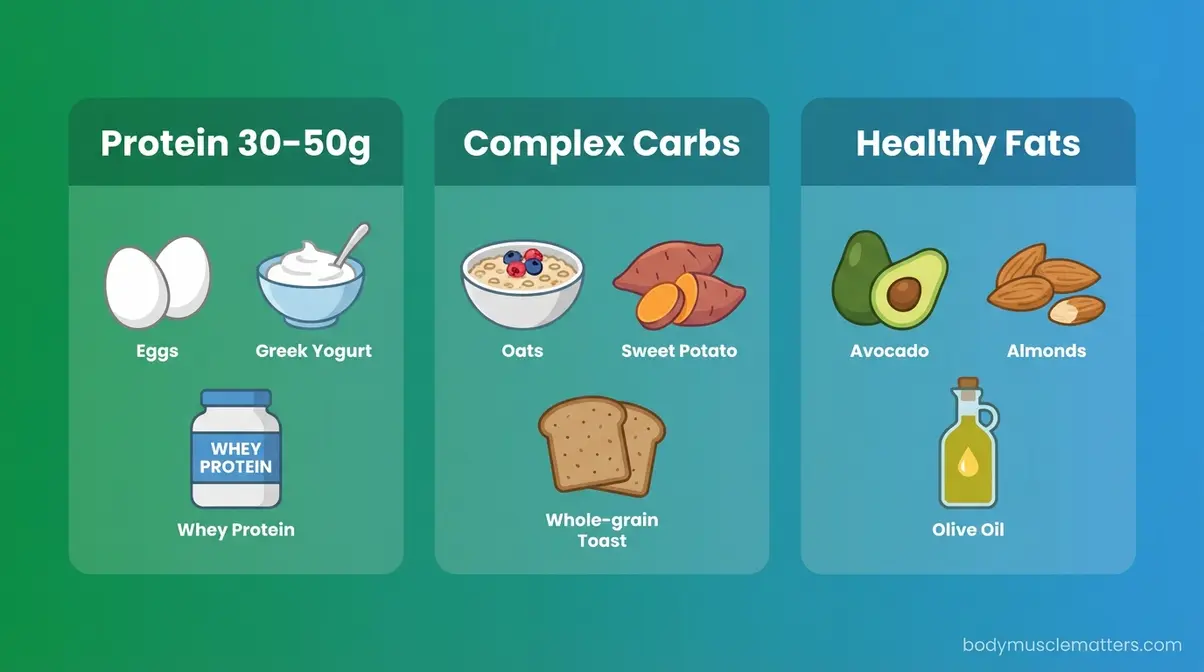
A bodybuilding breakfast needs three things: 30–50g of complete protein, a source of complex carbohydrates, and healthy fats — assembled according to your current phase. That last part is the foundation of The Phase-First Protocol — the principle that your bodybuilding phase determines your breakfast before any food choice does. Without phase alignment, even a technically solid meal can work against your goal.
So, what should bodybuilders eat for breakfast? The answer starts with your phase. Once you know whether you’re in a bulking, cutting, or maintenance window, your macro breakdowns become clear targets rather than guesses.
What Does a Breakfast Actually Need?
A complete bodybuilder breakfast requires three non-negotiable components, each playing a distinct role in muscle repair and performance.
Protein — the foundation. Research consistently supports 25–40g of protein per meal to maximally stimulate muscle protein synthesis (the biological process your body uses to build and repair muscle fibers) and shift your body toward an anabolic state (muscle-building mode) after an overnight fast (USADA, 2026; PMC, 2026). Complete proteins — meaning foods containing all essential amino acids — are the most effective. These include eggs, Greek yogurt, lean meats, and whey protein. Incomplete sources like most grains count toward your total, but they shouldn’t anchor a bodybuilder’s breakfast.
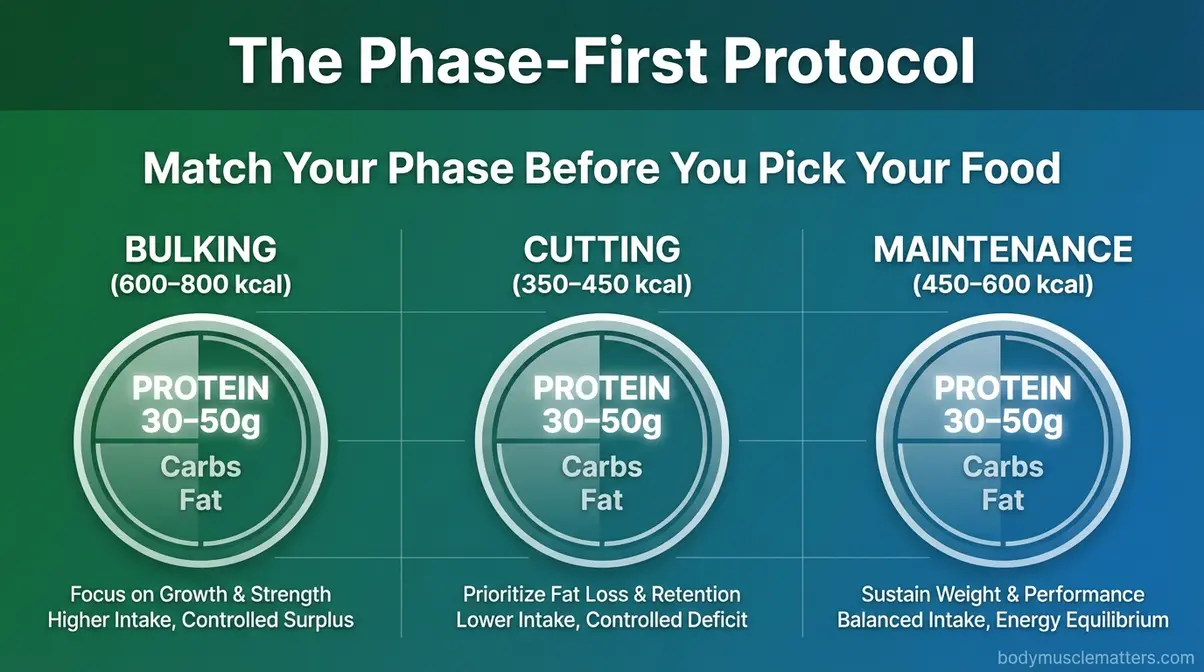
Caption: The Phase-First Protocol maps your bodybuilding phase to specific macro targets — the starting point for all 25 recipes in this guide.
BSW Health dietitians recommend 30–50g of complete protein at breakfast to initiate muscle protein synthesis (2026). Registered dietitians at BSW Health also note that protein quality matters — leucine-rich sources like whey and eggs are most effective at triggering the anabolic response.
Complex carbohydrates — the fuel. Carbs from oats, sweet potato, and whole-grain toast provide sustained energy during training and replenish muscle glycogen (stored energy your muscles draw on during lifts). Complex carbs have a lower glycemic index (a scale measuring how quickly a food raises blood sugar) than simple sugars, meaning they burn slowly rather than spiking and crashing your energy before you’ve reached the squat rack.
Healthy fats — the hormone support. Avocado, nuts, olive oil, and whole eggs all contribute to healthy fat intake, which supports testosterone production and other hormones critical to muscle growth. Fat also slows digestion — useful for sustained satiety through a long morning, but less ideal if you’re eating 30 minutes before a heavy training session.
A simple real-world example: 3 whole eggs + ½ cup oats + 1 tbsp almond butter = ~35g protein, 45g carbs, 18g fat. That’s a complete bodybuilder breakfast.
Bulking vs. Cutting Macro Splits
“Bulking” means eating in a caloric surplus of 300–500 kcal above maintenance to maximize muscle growth. “Cutting” means eating in a caloric deficit of 300–500 kcal below maintenance to reduce body fat while protecting muscle. A clean bulk specifically uses whole-food sources to achieve that surplus — not junk calories.
Research from the Performance Lab nutrition team aligns with USADA (2026) guidelines: bodybuilders should target 1.6–2.2g of protein per kg of body weight per day, adjusted based on phase goals.
The table below is your Phase-First Protocol in practice. Return to it any time your goal shifts.
| Phase | Calories | Protein | Carbs | Fat | Best Recipe Category |
|---|---|---|---|---|---|
| Bulking | 600–800 kcal | 40–55g | 60–90g | 15–25g | Savory & Hot (H2-3), Meal Prep |
| Cutting | 350–450 kcal | 35–50g | 20–40g | 8–14g | Quick & Cold (H2-2), Health-Specific |
| Maintenance | 450–600 kcal | 30–45g | 40–65g | 12–20g | Any category, moderate portions |
Why this matters per phase: Bulking targets higher carbs to fuel intense training sessions and support glycogen stores. Cutting prioritizes protein density per calorie to preserve muscle during a deficit. Maintenance sits between both — flexible enough to rotate across any recipe category in this article.
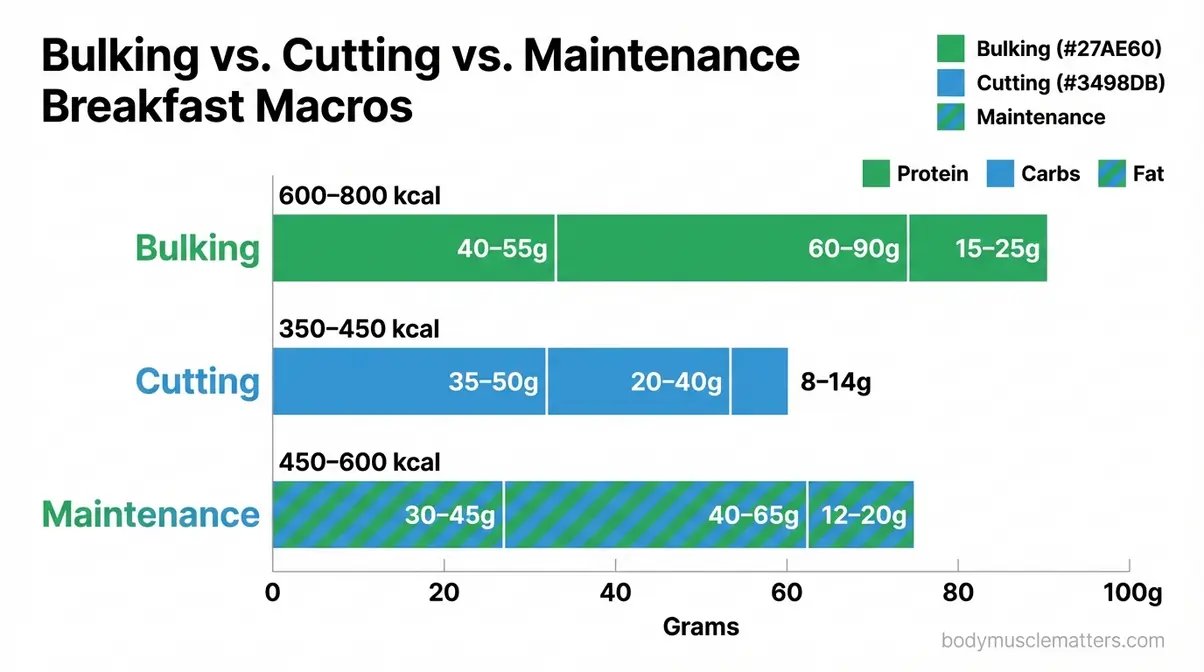
Caption: Use this chart alongside the recipe sections to quickly identify which meals match your current phase.
The 30-30-30 Rule & Research Evidence
The 30-30-30 rule — consuming 30 grams of protein within 30 minutes of waking, followed by 30 minutes of low-intensity cardio (like a brisk walk) — was popularized on social media by health creator Gary Brecka. The concept originated from Tim Ferriss’s 2010 book The 4-Hour Body and has since spread across fitness communities.
Here’s what the research actually supports: high-protein breakfasts of 30g+ reliably increase satiety, support muscle protein synthesis, and can improve eating behaviors throughout the day (Rupa Health, 2026). A study cited by the American Journal of Clinical Nutrition found that a 35g-protein breakfast reduced hunger more effectively than lower-protein alternatives. The specific “30-minute” waking window, however, is not as rigid as social media suggests — what matters more is hitting your protein target early in the day, not the clock.
The 30-30-30 Quick Reference:
- ✅ 30g protein — at or near breakfast; evidence supports this target for MPS and satiety
- ⏱️ 30-minute window — helpful as a habit cue, but not physiologically rigid
- 🚶 30 minutes low-intensity cardio — most beneficial during a cutting phase; optional during aggressive bulking
Practical application: During a cutting phase, the 30-30-30 rule is a powerful tool — the protein preserves muscle while the steady-state cardio (heart rate below 135 bpm) promotes fat oxidation without eating into recovery. During a heavy bulk, skip the mandatory cardio component and focus on hitting the protein target. Readers with heart conditions should consult a physician before beginning any morning cardio routine.
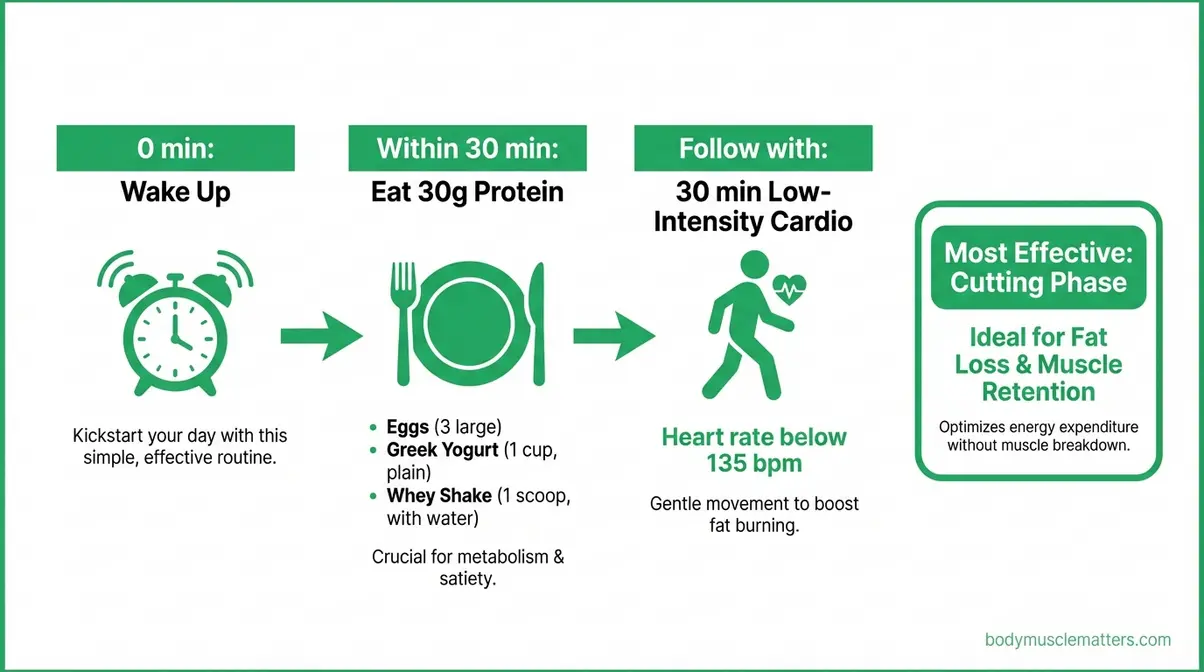
Caption: The 30-30-30 rule works best as a cutting-phase framework — the protein protects muscle while the cardio targets stored fat.
6 Quick, Cold High-Protein Breakfast Options
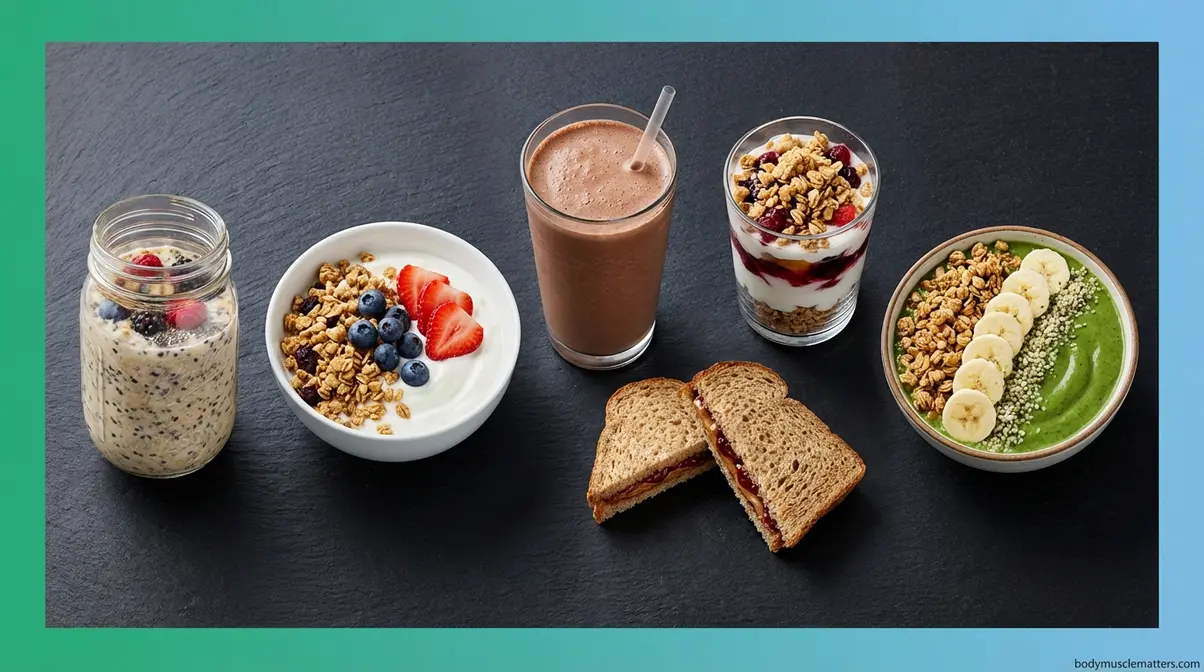
This section covers recipes #1–#6: Protein-Boosted Overnight Oats (Proats), Greek Yogurt Power Bowl, The Beastly Protein Shake, Protein-Packed Breakfast PB&J, Yogurt Parfait with Hemp Hearts, and Ultra-Filtered Milk Smoothie Bowl.
When your go-to high-protein breakfast needs to be ready in under five minutes, these six cold options deliver 30–60g of protein with zero cooking. Plain Greek yogurt alone provides 15–20g of protein per cup (USDA FoodData Central, 2026) — making dairy the fastest path to your morning protein target for early-morning lifters who train fasted or semi-fasted.
“Boiled egg, Oikos Pro yogurt drink, and a banana — or some vanilla-flavored Greek yogurt with a berry medley and almonds.”
— Common go-to breakfast shared across bodybuilding communities
These are the options that make that approach a structured, repeatable system rather than a guess.
#1 Protein-Boosted Overnight Oats
Proats — rolled oats combined with Greek yogurt or protein powder and refrigerated overnight to create a creamy, ready-to-eat breakfast — are the bodybuilder’s most practical cold option. They combine complex carbs (oats) with complete protein (Greek yogurt and whey) and require zero morning effort beyond opening the fridge.
- Ingredients:
- ½ cup rolled oats
- 1 cup plain Greek yogurt (0% or 2%)
- 1 scoop vanilla whey protein powder (~25g protein)
- ½ cup Fairlife ultra-filtered milk (ultra-filtered milk, such as Fairlife, contains roughly double the protein of regular milk per serving — ~13g vs. ~8g)
- 1 tbsp chia seeds
- ½ cup mixed berries
Macros: ~40g protein | ~55g carbs | ~8g fat | ~450 kcal
(Bulking version: add 2 tbsp almond butter → +180 kcal, +6g protein, +16g fat)
- Steps:
- Add oats and chia seeds to a jar or container.
- Add Greek yogurt and Fairlife milk.
- Stir in protein powder until fully combined.
- Top with berries, seal the container, and refrigerate overnight.
- Grab and eat in the morning — no reheating needed.
Beginner Tip: Prep 3 jars on Sunday night for Monday through Wednesday — oats keep well for 3 days refrigerated, and the texture actually improves by day two.
Phase Match: Bulking (add nut butter to hit 630 kcal) / Cutting (use ½ scoop protein, skip nut butter, keep berries for volume and fiber)
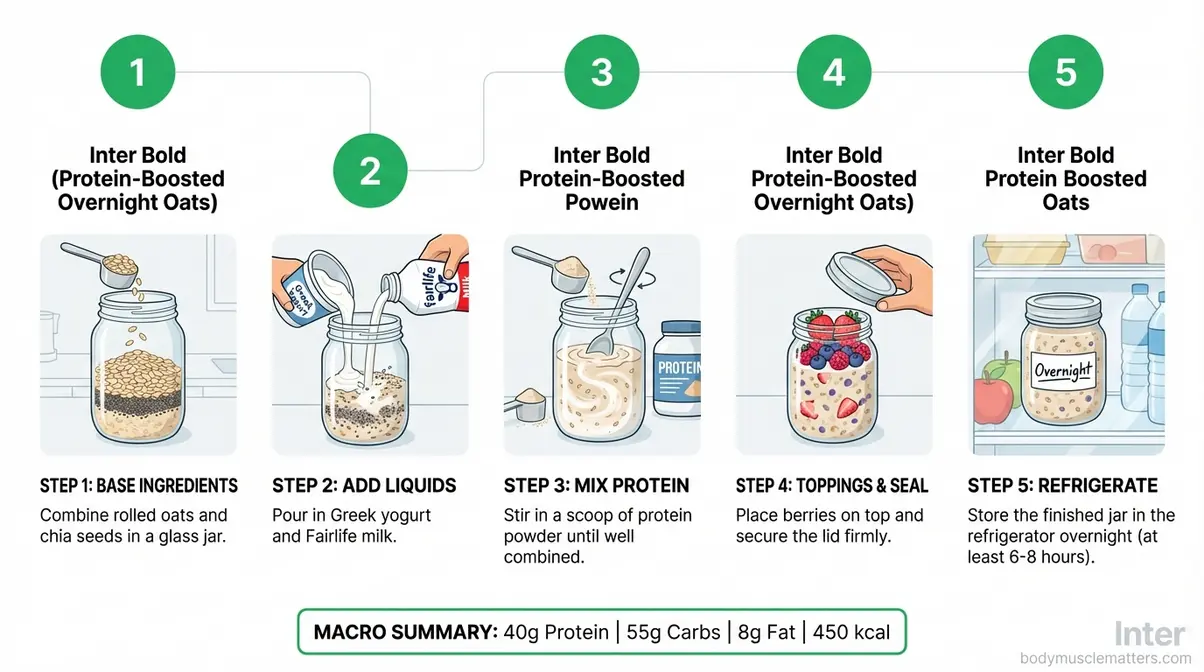
Caption: Proats are the gold standard cold breakfast — 40g protein with five minutes of Sunday prep and zero weekday effort.
Greek yogurt is already doing the heavy lifting in your proats. Now let’s build an entire power bowl around it.
#2 Greek Yogurt Power Bowl
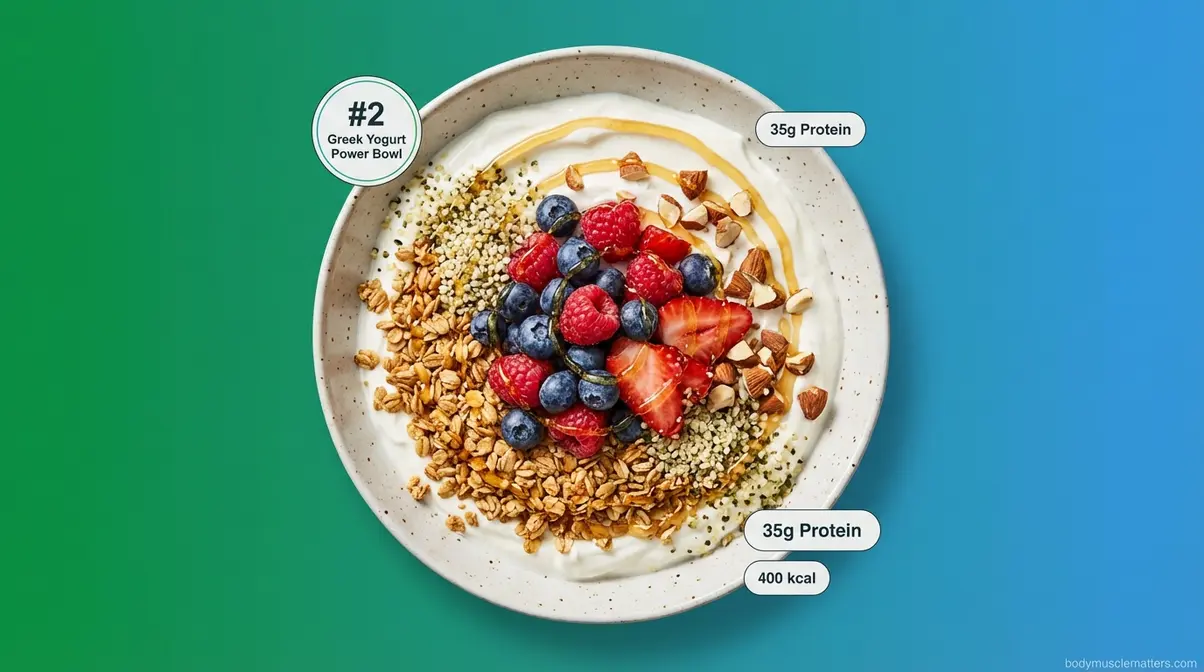
Plain Greek yogurt delivers 15–20g of protein per cup, making it the most protein-dense no-cook ingredient available to bodybuilders (USDA FoodData Central, 2026). The Oikos Pro series pushes this to 25g per cup — making a 1.5-cup base alone sufficient to nearly hit the 30g protein breakfast target before any toppings.
- Ingredients:
- 1.5 cups plain Greek yogurt (Oikos Pro or equivalent)
- ¼ cup granola (or puffed quinoa for lower sugar)
- 2 tbsp hemp hearts (~6g complete protein)
- ½ cup mixed berries
- 1 tbsp honey (bulking) or skip (cutting)
- 1 tbsp chopped almonds
Macros: ~35g protein | ~40g carbs | ~12g fat | ~400 kcal
(Cutting version without honey/granola: ~30g protein, ~20g carbs, 9g fat, ~310 kcal)
- Steps:
- Spoon Greek yogurt into a wide bowl.
- Scatter granola over the base.
- Add hemp hearts and almonds.
- Top with berries.
- Drizzle honey if bulking. Done in 3 minutes.
Beginner Tip: Hemp hearts are a nearly invisible protein add-in — sprinkle 2 tablespoons on any breakfast for a bonus 6g of complete protein with no change to flavor or texture.
Phase Match: Cutting (skip granola and honey, add cucumber slices for volume eating) / Bulking (double granola, stir a scoop of protein powder directly into the yogurt before assembling)
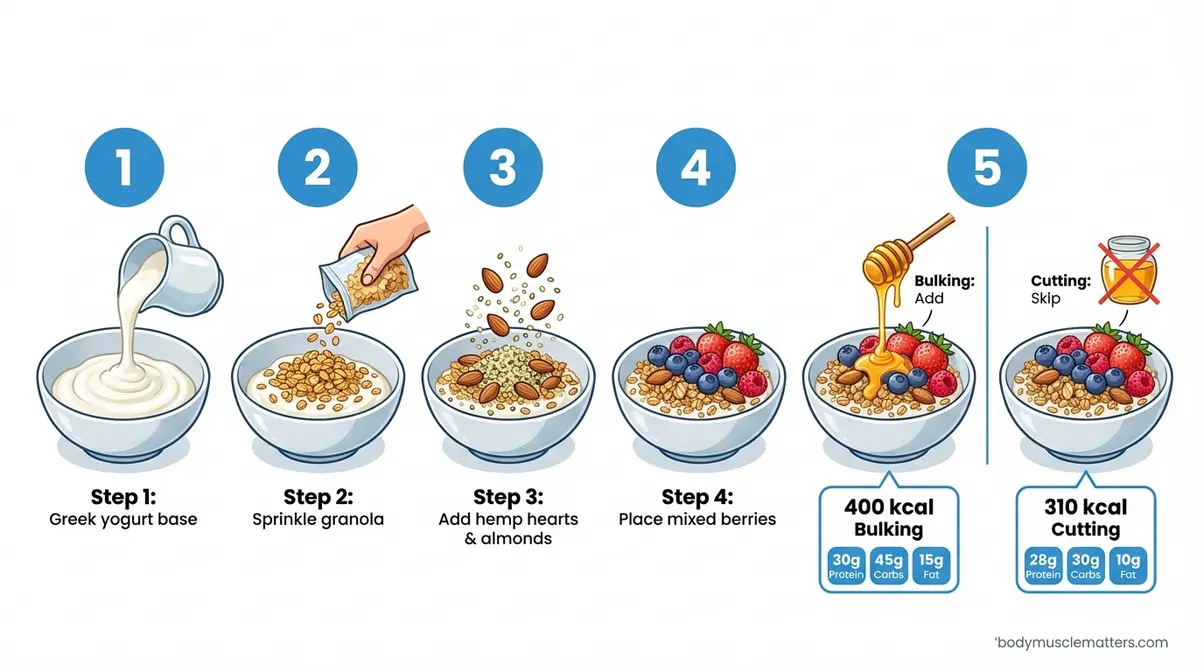
Caption: The Greek Yogurt Power Bowl scales from 310 kcal (cutting) to 500+ kcal (bulking) with two simple swaps.
Novi Health nutritionists confirm Greek yogurt and dairy-based protein sources as among the most effective high-protein breakfast anchors for muscle building (2026).
Not every morning calls for a bowl. Here are four more cold options you can grab, drink, or eat in under three minutes.
#3–#6 Quick Cold Breakfast Options
Recipe #3 — The Beastly Protein Shake
2 cups Fairlife milk + 2 scoops whey protein + 1 banana + 1 tbsp peanut butter. Blend for 60 seconds.
Macros: ~55g protein | ~60g carbs | ~14g fat | ~580 kcal
Best For: Bulking — maximum calories with zero prep time. Not For: Cutting — too calorie-dense for a deficit.
Recipe #4 — Protein-Packed Breakfast PB&J
2 slices Ezekiel bread + 2 tbsp natural peanut butter + 1 tbsp jam + 1 scoop protein shake on the side.
Macros: ~35g protein | ~55g carbs | ~16g fat | ~500 kcal
Best For: Portable, on-the-road eating — the Bro-fast (a quick bodybuilder breakfast assembled with minimal equipment) of cold options. Not For: Cutting phases where calorie budget is tight.
Recipe #5 — Yogurt Parfait with Hemp Hearts & Berries
1 cup Greek yogurt + ¼ cup granola + 3 tbsp hemp hearts + ½ cup frozen berries (thawed overnight).
Macros: ~32g protein | ~38g carbs | ~10g fat | ~375 kcal
Best For: Cutting or maintenance; a lower-calorie version of the Power Bowl. Not For: Aggressive bulking without adding a protein shake on the side.
Recipe #6 — Ultra-Filtered Milk Smoothie Bowl
1 cup Fairlife ultra-filtered milk + ½ banana (frozen) + ½ cup frozen spinach + 1 scoop protein powder. Blend thick, eat with a spoon, top with granola.
Macros: ~40g protein | ~35g carbs | ~5g fat | ~345 kcal
Best For: Cutting — high protein, lower calorie, high volume eating that keeps you full. Not For: Anyone who dislikes the taste of spinach (though the banana masks it almost entirely).
Cold options are efficient. But sometimes the body craves something substantial. These seven savory, hot breakfasts are built for serious caloric and protein loads.
Savory & Hot: 7 Hearty Muscle-Building Breakfasts
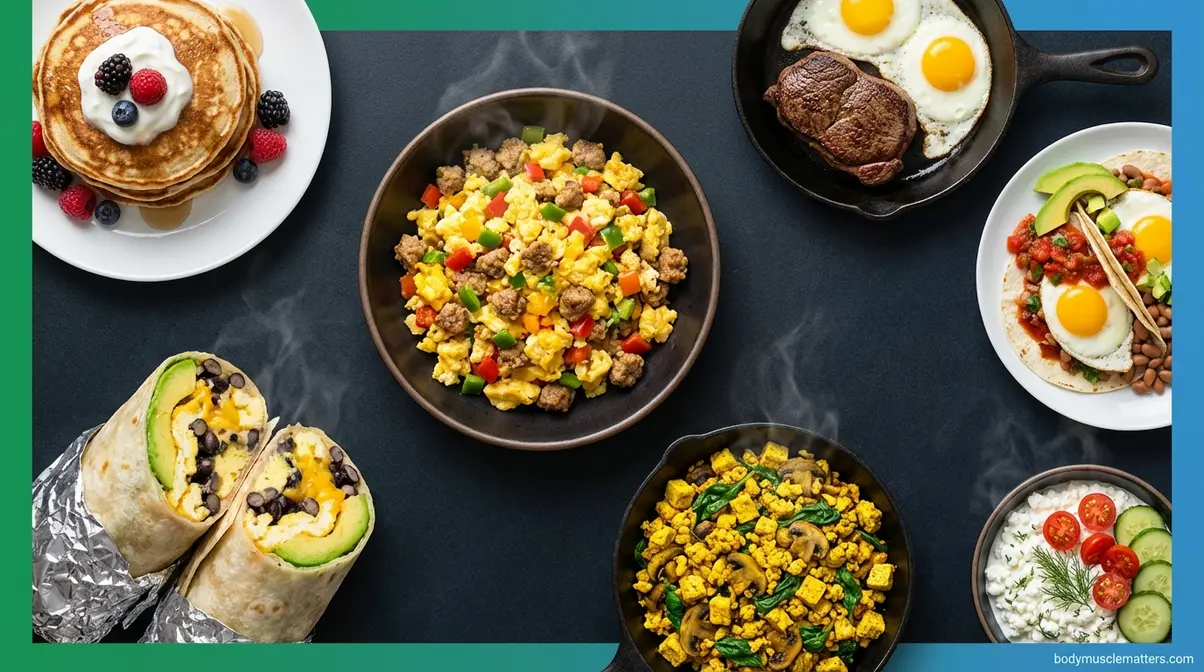
This section covers recipes #7–#13: Classic Bodybuilder Egg Scramble, Protein Pancakes, Steak & Eggs, Mexican Eggs, Avocado Breakfast Burrito, Tofu Scramble, and Cottage Cheese Bowl.
Across bodybuilding communities — from Reddit’s r/naturalbodybuilding to competitive prep forums — the classic egg-based scramble consistently ranks as the most reported go-to high-protein breakfast for serious lifters. Whole eggs provide ~6g of complete protein each, with all essential amino acids and fat-soluble vitamins (USDA FoodData Central, 2026). These are the Bro-fast meals (a quick, protein-maximizing bodybuilder breakfast built from whole foods like eggs, meat, and complex carbs) — designed for Gainz Upon Gainz (maximum muscle recovery and growth from your morning meal).
Across bodybuilding communities, the classic egg white scramble with lean turkey is the most consistently reported go-to high-protein breakfast — delivering 40–60g protein per serving (aggregated from r/naturalbodybuilding community discussions, 2026).
#7 Classic Bodybuilder Egg Scramble
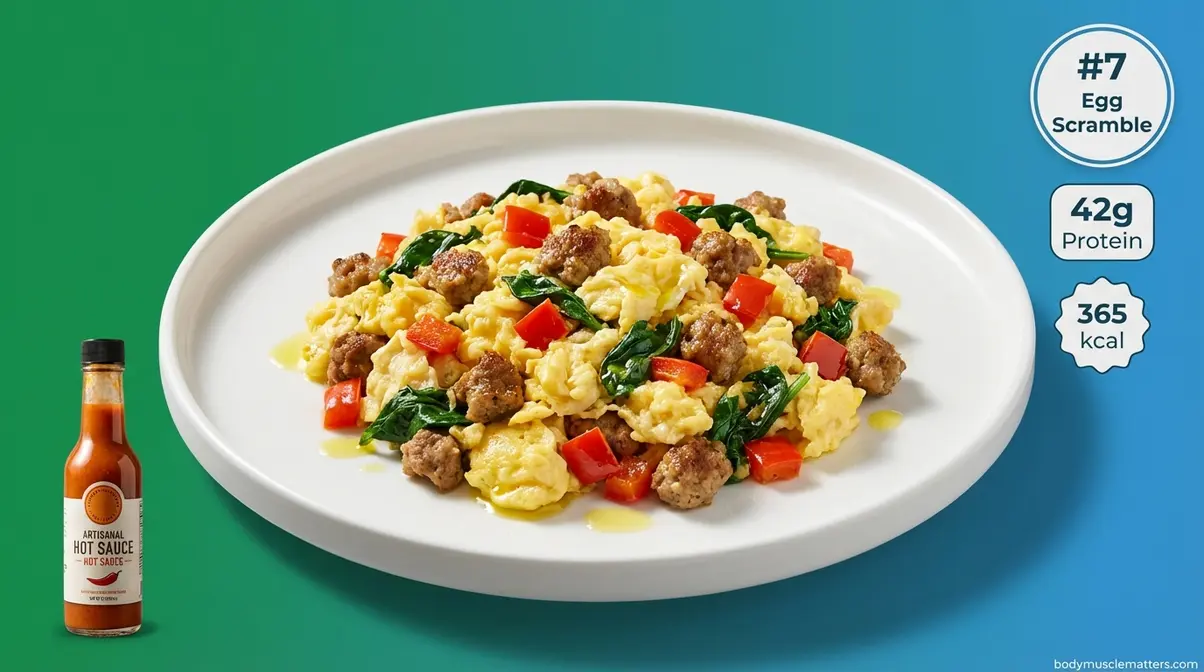
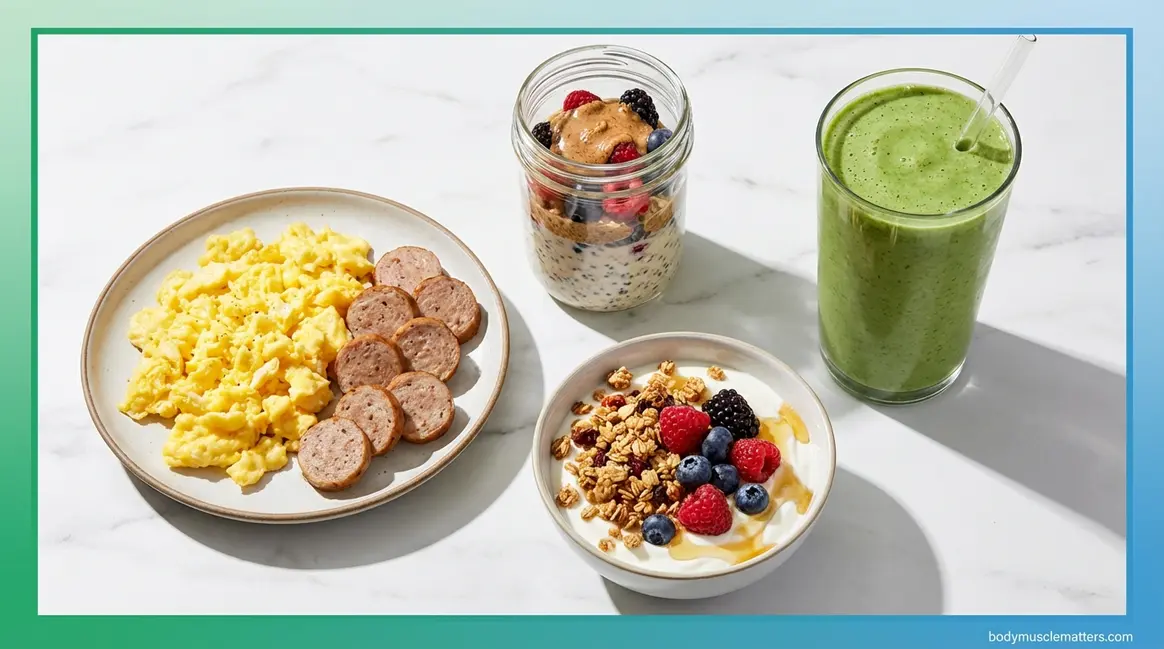
These seven options represent the most popular healthy breakfast ideas for bodybuilders who want maximum protein per meal — and the egg scramble leads the category. Whole eggs (one of the most complete protein sources available, each providing ~6g protein with all essential amino acids and muscle-supporting cholesterol precursors) combined with egg whites (the fat-free protein fraction of an egg, containing ~4g protein per white) and lean turkey sausage (a lower-saturated-fat alternative to pork sausage with comparable protein content) form the foundation of the classic “Bro-fast.”
A quick note on the whole egg debate: the American Heart Association recognizes the nutritional benefits of eggs and recommends up to 2 eggs per day within the context of a heart-healthy diet (2026 Dietary Guidelines for Americans, AHA). Mayo Clinic notes that most healthy adults can eat up to 7 eggs per week without increasing heart disease risk (Mayo Clinic, 2026). A 2 whole egg + 4 egg white combination balances cholesterol precursors for testosterone production against protein density — the approach most commonly used in bodybuilding communities.
- Ingredients:
- 2 whole eggs + 4 large egg whites
- 3 oz lean turkey sausage (or ground turkey)
- ½ cup chopped bell peppers and spinach
- 1 tsp olive oil
- Salt, pepper, optional hot sauce
Macros: ~42g protein | ~8g carbs | ~18g fat | ~365 kcal
(Add 1 slice whole-grain toast: +4g protein, +25g carbs, ~200 kcal more for bulking)
- Steps:
- Heat olive oil in a nonstick pan over medium heat.
- Add turkey sausage and cook for 3–4 minutes until browned.
- Add bell peppers and spinach, cook for 2 minutes.
- Whisk eggs and egg whites together, then pour into pan.
- Scramble until just set — avoid overcooking.
- Season with salt, pepper, and hot sauce. Serve immediately.
Beginner Tip: Use a nonstick pan and medium — not high — heat. High heat causes eggs to become rubbery. You’re going to eat this meal regularly, so make it taste good from day one.
Phase Match: Bulking (add toast + an extra whole egg for a 550-kcal version) / Cutting (use 6 egg whites only, skip toast, add extra spinach for volume)
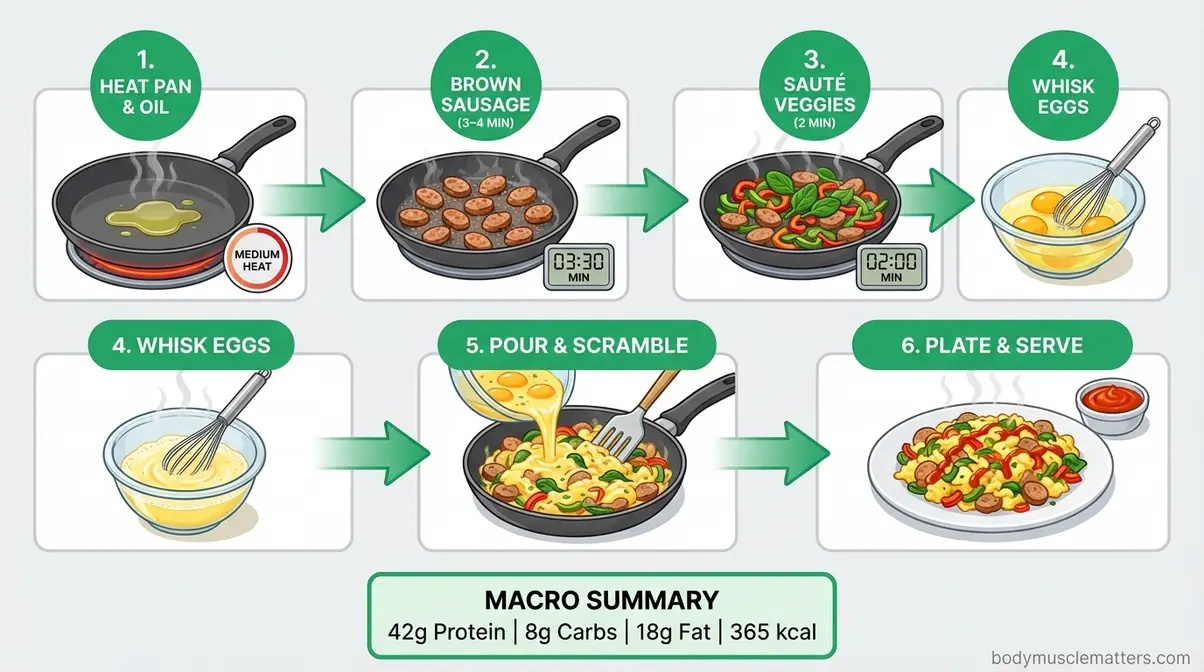
Caption: The 6-step egg scramble delivers 42g of protein in under 10 minutes — the cornerstone of any serious bodybuilding breakfast rotation.
Eggs don’t have to be savory. Protein pancakes give you the same muscle-building fuel in a format that tastes like a treat.
#8 Protein Pancakes
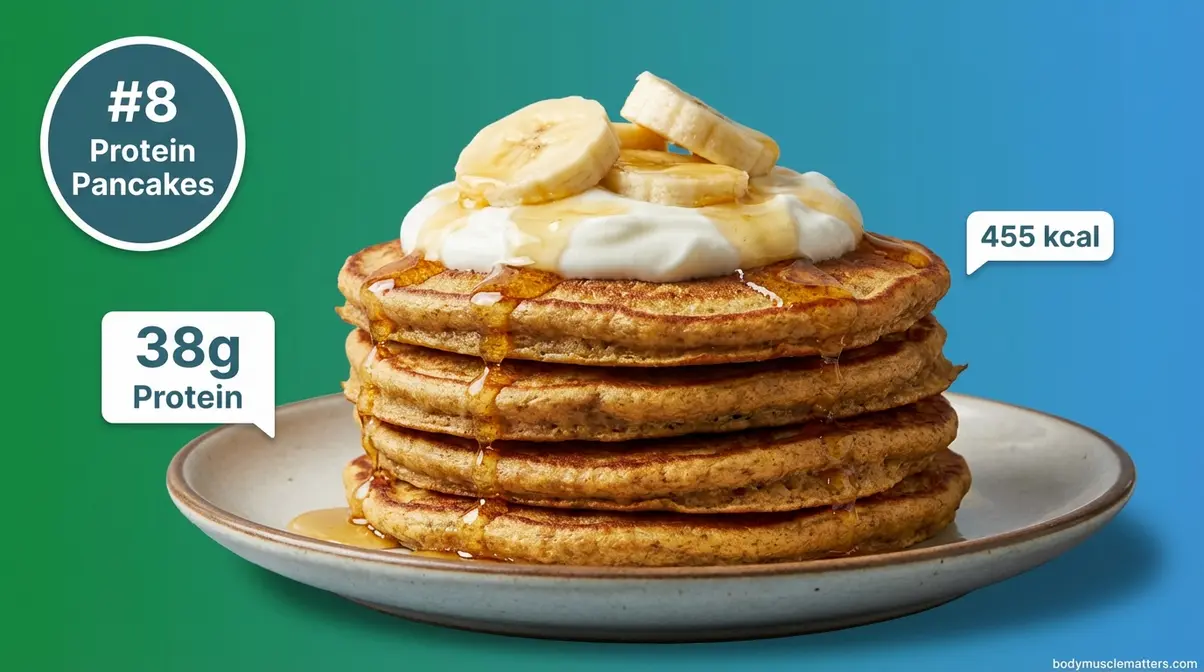
Regular pancakes average ~5g of protein per serving with a high glycemic load — a blood sugar spike followed by an energy crash. Protein pancakes built from oat flour and whey flip this entirely: ~35–40g protein, slower-digesting carbs, and enough caloric density for both bulking and cutting versions. For beginners who feel like eating for muscle means sacrificing enjoyment, this recipe is the proof point.
- Ingredients:
- ½ cup rolled oats (blended into flour)
- 2 whole eggs
- 1 scoop vanilla whey protein powder
- ½ cup Fairlife milk or unsweetened almond milk
- ½ tsp baking powder
- Pinch of salt
- Optional: ½ mashed banana for natural sweetness
Macros: ~38g protein | ~48g carbs | ~12g fat | ~455 kcal
(Cutting version without banana: ~36g protein, ~38g carbs, ~415 kcal)
- Steps:
- Blend rolled oats into fine flour using a blender.
- Whisk all ingredients together until smooth.
- Pour batter into a heated nonstick pan over medium-low heat.
- Cook until bubbles form across the surface (~2 minutes), then flip.
- Cook for 90 more seconds on the second side. Makes 4–5 small pancakes.
Beginner Tip: Blend your oat flour in bulk on Sunday and store it in a sealed bag for the week — this shaves 2 minutes off weekday prep and makes the recipe feel effortless.
Phase Match: Bulking (top with Greek yogurt + honey + banana slices for +15g protein and +200 kcal) / Cutting (use almond milk, skip banana, reduce to 1.5 scoops oat flour)
For the days you want maximum protein with minimum prep time, these five additional savory options cover every scenario.
#9–#13 More Savory Hot Breakfasts
Recipe #9 — Steak & Eggs (The Classic Bulk)
4oz lean flank steak (leftover from dinner works perfectly) + 3 whole eggs scrambled or fried.
Macros: ~55g protein | ~2g carbs | ~24g fat | ~445 kcal
Best For: Aggressive bulking; post-rest-day recovery. Not For: Cutting (high total fat from steak + yolks).
Recipe #10 — Mexican Eggs (Huevos Rancheros-Style)
3 whole eggs scrambled + ½ cup black beans (~8g protein) + salsa + 1 small corn tortilla.
Macros: ~32g protein | ~40g carbs | ~14g fat | ~415 kcal
Best For: Bulking with solid fiber from beans; culturally varied flavor to keep the diet sustainable. Not For: Low-carb cutting phases.
Recipe #11 — Avocado Breakfast Burrito
3 egg whites + 2 whole eggs scrambled + ½ avocado + salsa, wrapped in a whole-wheat tortilla.
Macros: ~38g protein | ~42g carbs | ~18g fat | ~475 kcal
Best For: Bulking or maintenance; portable when wrapped tightly in foil. Not For: Strict cutting due to avocado fat content.
Recipe #12 — Tofu Scramble (Vegan)
6oz firm tofu crumbled + turmeric + cumin + 2 tbsp nutritional yeast (+8g protein) + spinach, sautéed in olive oil.
Macros: ~28g protein | ~10g carbs | ~14g fat | ~270 kcal
Best For: Vegan or dairy-free bodybuilders; cutting phase. Add 2 tbsp hemp hearts to push protein to ~34g. Not For: Anyone who needs 50g+ protein from a single meal without supplementation.
Recipe #13 — Cottage Cheese Bowl (Savory Version)
1 cup low-fat cottage cheese + sliced cucumber + cherry tomatoes + everything bagel seasoning + 2 rice cakes on the side.
Macros: ~30g protein | ~22g carbs | ~4g fat | ~245 kcal
Best For: Cutting phase — maximum protein density per calorie, near-zero cooking. Not For: Bulking without significant additions (add a full egg on the side and a piece of toast).
Where the savory hot breakfasts deliver the highest protein ceilings per meal, meal-prep breakfasts solve a different problem entirely: consistency during a chaotic week.
5 Meal-Prep Breakfasts for Busy Bodybuilders
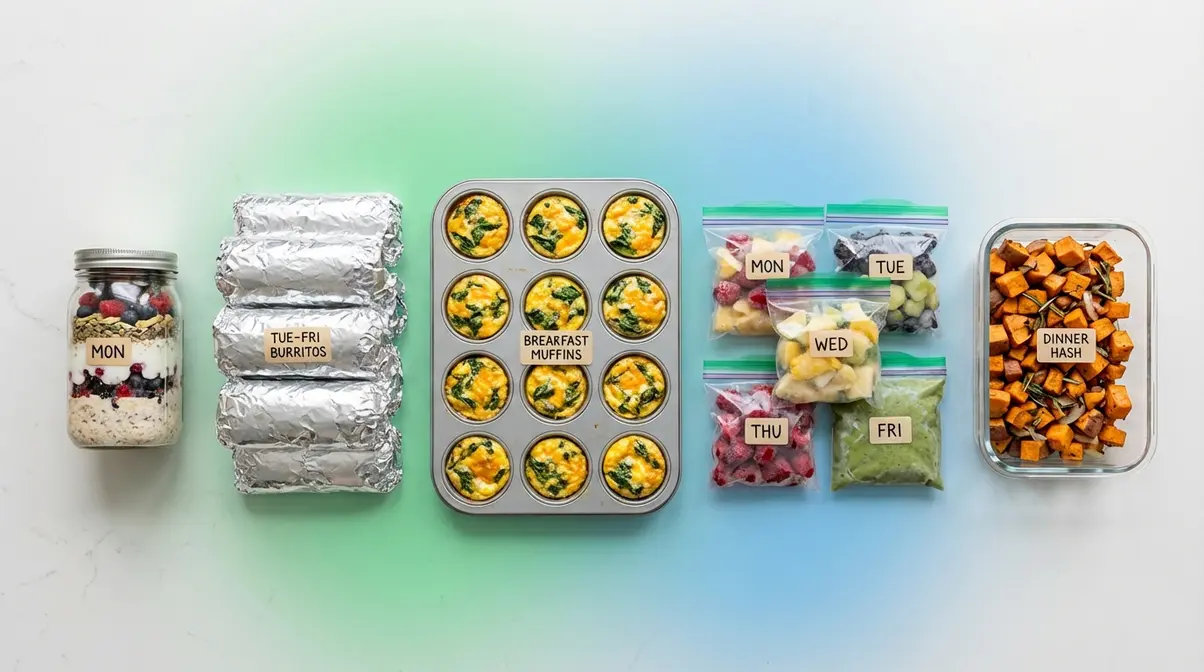
This section covers recipes #14–#18: Egg & Veggie Muffins, Budget Breakfast Burritos, Bodybuilder Smoothie Packs, High-Calorie Bulking Overnight Cereal, and Sweet Potato Hash.
Budget-friendly meal prep is the bodybuilder’s secret to staying on-diet through a chaotic work week. These five breakfasts are designed to be batch-cooked in approximately 45 minutes on Sunday — giving you a full work-week of compliant, macro-matched morning meals without opening a delivery app or making a single weekday decision.
#14 Batch Egg & Veggie Muffins
Egg muffins — individual-portioned baked egg cups made in a muffin tin — are the gold standard of bodybuilder meal prep. They store in the fridge for 5 days, reheat in 60 seconds, and scale to whatever protein or vegetable combination you have on hand.
What You’ll Need: 12-cup muffin tin, nonstick cooking spray, mixing bowl, whisk. Optional: mini muffin tin for 24 smaller portions.
- Ingredients (makes 12 muffins):
- 8 whole eggs + 6 egg whites, whisked
- ½ cup diced bell peppers
- ½ cup chopped spinach
- ½ cup diced turkey sausage or lean ham (~15g additional protein)
- ¼ cup shredded low-fat cheese
- Salt, pepper, garlic powder to taste
Macros per 2 muffins: ~22g protein | ~3g carbs | ~10g fat | ~190 kcal
(Eat 3 muffins for a complete ~33g protein serving)
- Steps:
- Preheat oven to 375°F (190°C).
- Coat a 12-cup muffin tin thoroughly with nonstick spray.
- Whisk eggs and egg whites with salt, pepper, and garlic powder in a large bowl.
- Distribute vegetables and turkey sausage evenly across all 12 cups.
- Pour egg mixture into each cup, filling to about ¾ full.
- Top with a pinch of shredded cheese per cup.
- Bake for 18–22 minutes until eggs are set and tops are lightly golden.
- Cool completely before storing in an airtight container in the fridge.
Storage: 5 days refrigerated; reheat at 50% microwave power for 45–60 seconds to avoid rubbery texture.
Beginner Tip: Line the muffin tin with silicone cups instead of spray — they release effortlessly and eliminate the pan-scrubbing step entirely.
Phase Match: Cutting (eat 3 muffins + ½ cup berries, ~33g protein, ~200 kcal) / Bulking (eat 4 muffins + 2 slices toast + ½ avocado, ~45g protein, ~500 kcal)
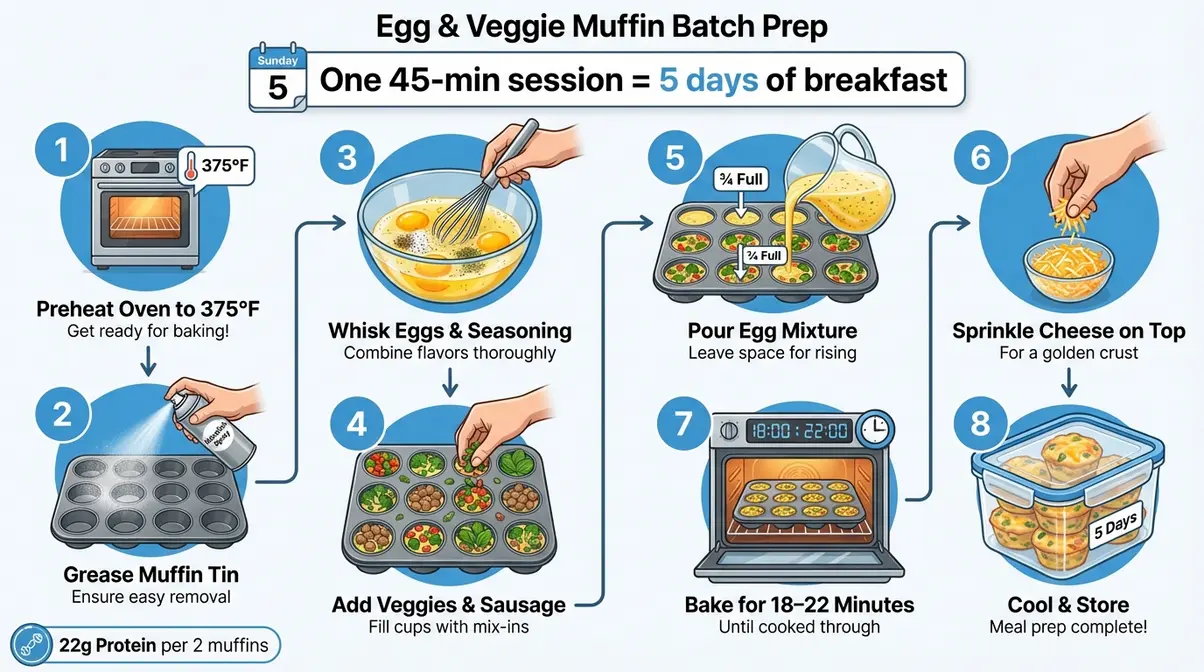
Caption: One 45-minute Sunday session produces 12 muffins — a full week of grab-and-go, macro-compliant breakfasts.
#15 Budget Breakfast Burritos
Breakfast burritos — a portable wrapped meal that freezes well for up to 3 months — solve the dual challenge of budget and consistency. Based on current ingredient prices, this batch recipe costs approximately $7–9 per day to sustain a full bodybuilding breakfast rotation, making it one of the most cost-efficient high-protein meal prep options available.
- Ingredients (makes 5 burritos):
- 8 whole eggs + 4 egg whites
- 1 cup canned black beans (drained, rinsed — ~24g protein total)
- 5 whole-wheat tortillas (medium)
- 1 cup salsa
- ½ cup shredded low-fat cheddar
- 1 cup frozen diced peppers and onions (thawed)
- Optional: 5oz lean ground turkey, cooked
Macros per burrito: ~33g protein | ~40g carbs | ~12g fat | ~395 kcal
(Add ground turkey: ~42g protein, ~450 kcal)
- Steps:
- Cook peppers and onions in a nonstick pan for 3 minutes.
- Add eggs (whisked) and black beans; scramble together over medium heat.
- Remove from heat; divide into 5 portions.
- Spoon each portion onto the center of a tortilla; top with salsa and cheese.
- Fold sides inward, roll tightly into a burrito.
- Wrap individually in foil or plastic wrap.
Storage: Refrigerate for 4 days or freeze up to 3 months. Reheat from frozen: remove foil, microwave 2.5 minutes, flip, microwave 1 more minute.
Beginner Tip: Label each burrito with a sticky note indicating the day to eat it — it sounds obvious, but it removes the decision fatigue that derails diet consistency.
Phase Match: Cutting (skip cheese, reduce beans to ½ cup per burrito, ~28g protein, ~330 kcal) / Bulking (add ground turkey + extra cheese, ~42g protein, ~480 kcal)
#16–#18 Prep-Ahead Breakfasts
Recipe #16 — Bodybuilder Smoothie Packs
Pre-portion smoothie ingredients into individual ziplock bags: 1 cup Fairlife milk, 1 scoop protein powder, 1 frozen banana, 1 cup frozen spinach, 1 tbsp almond butter. Freeze the bags; blend one each morning in under 2 minutes.
Macros: ~42g protein | ~45g carbs | ~10g fat | ~435 kcal
Best For: Busy mornings requiring under 2 minutes of active time; bulking phase. Not For: Cutting (use half banana, reduce almond butter).
Recipe #17 — High-Calorie Bulking Overnight Cereal
1 cup plain Greek yogurt + ½ cup rolled oats (dry) + ½ cup Fairlife + 2 tbsp almond butter + 1 tbsp honey + ¼ cup granola. Mix, refrigerate overnight, eat cold.
Macros: ~38g protein | ~75g carbs | ~20g fat | ~625 kcal
Best For: Hard gainers and aggressive bulking phases — one of the highest-calorie cold prep options in this article. Not For: Cutting or maintenance.
Recipe #18 — Sweet Potato Hash (Batch)
Dice and roast 2 large sweet potatoes (a complex carbohydrate with a low-to-moderate glycemic index that provides sustained energy without blood sugar spikes) + 6oz lean chicken sausage (sliced) + 1 diced onion + 1 bell pepper, in olive oil at 400°F for 25 minutes. Makes 4 servings.
Macros per serving: ~30g protein | ~42g carbs | ~10g fat | ~375 kcal
Best For: Meal-prep Sunday for athletes who prefer savory over sweet; maintenance or lean bulk. Not For: Strict cutting without reducing sausage and sweet potato portions.
Cooking every morning isn’t realistic for everyone. When health conditions add another layer of complexity to breakfast choices, the Phase-First Protocol needs one more variable: your medical context.
Breakfasts for Cholesterol, Diabetes & GLP-1
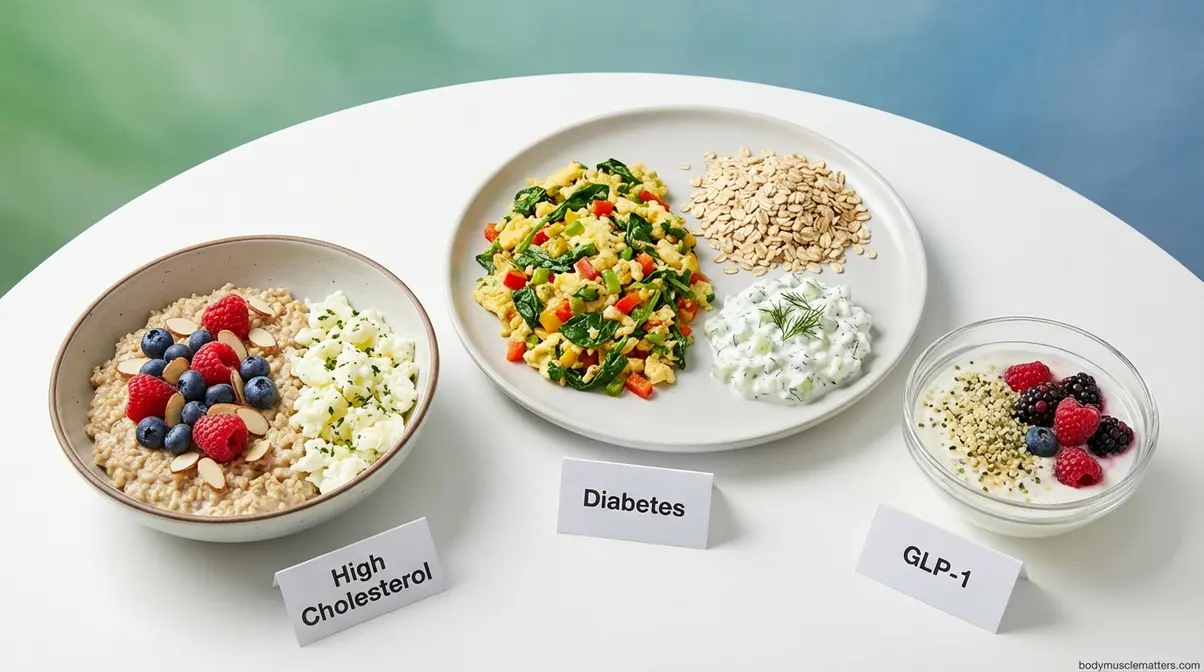
Medical Disclaimer: The information in this section is for educational purposes only and does not constitute medical advice. If you have high cholesterol, diabetes, or are taking GLP-1 medications (such as Ozempic or Wegovy), consult your doctor or a Registered Dietitian before making significant dietary changes.
These health-specific breakfast adaptations represent a content gap that no competitor currently addresses: bodybuilders managing cardiometabolic conditions need different breakfast strategies, and generic “high-protein” advice can actively work against their health goals without the right guidance.
If You Have High Cholesterol
A bodybuilder with high cholesterol can still hit 30–50g of protein at breakfast — but the source of that protein matters significantly more than the amount. The key distinction is saturated fat, not dietary cholesterol alone. Research from the American Heart Association indicates that dietary saturated fat is a stronger driver of elevated LDL cholesterol than dietary cholesterol itself (AHA, 2026). This means eggs are not automatically off the table — but full-fat sausage, cheese, and butter require moderation.
Recommended swaps for bodybuilders with high cholesterol:
| Standard Ingredient | Cholesterol-Friendly Swap | Impact |
|---|---|---|
| Whole eggs (4+) | 2 whole eggs + 4 egg whites | Reduces saturated fat by ~40% |
| Pork sausage | Lean turkey sausage or chicken sausage | Reduces saturated fat ~50% |
| Full-fat Greek yogurt | Non-fat Greek yogurt (Oikos Pro 0%) | Same protein, ~70% less saturated fat |
| Butter for cooking | Olive oil or nonstick spray | Eliminates saturated fat from cooking |
| Granola with coconut oil | Oat-based granola with nuts | Adds soluble fiber (binds LDL) |
High-cholesterol bodybuilder breakfast example — Recipe #19: Oatmeal + Egg White Scramble
½ cup steel-cut oats (provides ~4g soluble fiber, which binds LDL cholesterol and supports its removal from the body) + ½ cup mixed berries + 5 egg whites scrambled with spinach + 1 tbsp ground flaxseed.
Macros: ~34g protein | ~48g carbs | ~6g fat | ~375 kcal
Soluble fiber from oats has strong evidence behind it for LDL reduction, and it pairs naturally with a high-protein egg white scramble — one of the cholesterol-conscious bodybuilder’s most powerful breakfast combinations (Healthline, 2026).
If You Have Diabetes or Pre-Diabetes
A high-protein, lower-glycemic breakfast is among the most effective dietary strategies for blood sugar management in people with diabetes — and it aligns naturally with bodybuilding nutrition goals (American Diabetes Association, 2026). The priority is minimizing blood sugar spikes while still hitting protein targets.
- Key principles for diabetic bodybuilders, per the ADA (2026):
- Choose protein-first meals — protein has minimal impact on blood glucose
- Pair carbs with fiber and fat — this slows glucose absorption and reduces post-meal spikes
- Avoid high-sugar add-ins — honey, sweetened granola, fruit juice are common culprits in otherwise healthy breakfasts
- Opt for whole grains over refined — oats, Ezekiel bread, and sweet potatoes over white bread and regular cereals
Diabetes-friendly bodybuilder breakfast example — Recipe #20: Veggie Egg Scramble + Steel-Cut Oats
3 whole eggs scrambled with bell peppers, spinach, and mushrooms (zero-carb additions) + ½ cup steel-cut oats (plain, no sugar) on the side.
Macros: ~32g protein | ~28g carbs | ~16g fat | ~355 kcal
Recipe #21: Cottage Cheese & Cucumber Plate
1 cup low-fat cottage cheese + sliced cucumber + 1 tbsp hemp hearts + 2 whole-grain rye crackers.
Macros: ~30g protein | ~18g carbs | ~6g fat | ~245 kcal
This low-carb option is among the least blood-sugar-disruptive high-protein breakfasts available, making it ideal for pre-diabetics monitoring A1C (a 3-month average blood sugar level) levels.
If You’re Taking GLP-1 Medications
GLP-1 medications — a class of medications like Ozempic or Wegovy (semaglutide) used for blood sugar and weight management — dramatically reduce appetite and slow gastric emptying. This changes the breakfast calculus considerably. A 2026 review study cited by AARP recommends at least 60g of protein per day for GLP-1 patients to preserve lean muscle mass during the weight loss these medications induce (AARP, citing 2026 review, 2026). The challenge: GLP-1 users often can’t eat a large breakfast.
The solution is volume-efficient, protein-dense, small-portion breakfasts:
- Small meals, high protein-to-calorie ratio — aim for 25–30g protein in 250–350 kcal
- Avoid greasy or high-fat foods — they worsen nausea, a common GLP-1 side effect
- Prioritize easy-to-digest protein sources — Greek yogurt, cottage cheese, eggs, and protein shakes are better tolerated than heavy meats early in the day
- Eat slowly — GLP-1 medications slow digestion; eating too fast can cause discomfort
Recipe #22: GLP-1 Optimized Yogurt Cup
¾ cup plain non-fat Greek yogurt + 1 tbsp hemp hearts + ¼ cup berries + ½ scoop whey protein stirred in.
Macros: ~26g protein | ~15g carbs | ~4g fat | ~200 kcal
Why it works: Small volume, easy to digest, high protein-to-calorie ratio — ideal for a reduced appetite.
Recipe #23: Two-Egg Spinach Scramble
2 whole eggs scrambled with 1 cup spinach + 1 slice whole-grain toast.
Macros: ~18g protein | ~18g carbs | ~12g fat | ~250 kcal
Follow with a ½ scoop protein shake 60–90 minutes later to reach 30g+ total morning protein without overwhelming digestive capacity in one sitting.
⚕️ Consult your prescribing physician before making significant changes to your breakfast routine while taking GLP-1 medications. Dietary changes can affect medication efficacy and side effect profiles.
Vegan & Dairy-Free Adaptations
Vegan bodybuilders face the same protein targets with fewer animal-based shortcuts. These two recipes demonstrate that plant-based morning protein is achievable — with some planning.
Recipe #24: High-Protein Tofu Toast
2 slices whole-grain bread toasted + 4oz firm silken tofu blended smooth (mimics ricotta texture) + 2 tbsp nutritional yeast (adds ~8g protein + B12) + sliced cucumber and tomato on top.
Macros: ~28g protein | ~38g carbs | ~8g fat | ~335 kcal
Best For: Vegan bodybuilders in cutting or maintenance phase. Add hemp hearts for +6g protein with zero prep.
Recipe #25: Vegan Protein Smoothie Bowl
1 cup soy milk (higher protein than almond milk at ~7g/cup) + 1 scoop plant-based protein powder + ½ cup frozen edamame (shelled) + 1 frozen banana. Blend thick, top with 2 tbsp hemp hearts + granola.
Macros: ~38g protein | ~55g carbs | ~10g fat | ~460 kcal
Best For: Vegan bulking phase — one of the highest-protein plant-based breakfast options in this list.
The Phase-First Decision Matrix
The Phase-First Protocol comes down to one question before every breakfast: What phase am I in right now? This matrix maps your answer directly to the right recipe category.
| Your Goal | Best Recipe Category | Top Pick | Protein Target | Calorie Target |
|---|---|---|---|---|
| Aggressive Bulking | Savory & Hot (#7–#13) | Steak & Eggs (#9) | 50–60g | 600–800 kcal |
| Clean Bulk | Meal Prep (#14–#18) | Budget Burrito (#15) | 40–50g | 500–650 kcal |
| Cutting | Quick & Cold (#1–#6) | Smoothie Bowl (#6) | 35–50g | 300–450 kcal |
| Maintenance | Any category | Proats (#1) | 30–45g | 400–550 kcal |
| High Cholesterol | Health-Specific (#19) | Oatmeal + Egg Whites | 30–40g | 350–450 kcal |
| Diabetes / Pre-Diabetes | Health-Specific (#20–#21) | Veggie Scramble (#20) | 30–40g | 300–400 kcal |
| GLP-1 User | Health-Specific (#22–#23) | Yogurt Cup (#22) | 25–30g | 200–300 kcal |
| Vegan / Dairy-Free | Vegan Adaptations (#24–#25) | Vegan Smoothie Bowl (#25) | 35–40g | 400–500 kcal |
Quick Decision Tree:
Start → “Do you have a health condition (cholesterol, diabetes, GLP-1)?”
→ Yes → Go to Section 5 and Decision Matrix rows 5–7 above.
→ No → “Are you currently bulking or cutting?”
→ Bulking → Savory & Hot (Section 3) or Meal Prep (Section 4)
→ Cutting → Quick & Cold (Section 2) or Health-Specific low-cal options
→ Unsure → Start with Proats (#1) — they work for both phases with one swap
Common Mistakes, Swaps & When to See a Dietitian
Breakfast Mistakes That Hurt Your Gains
Beginners make four high-frequency breakfast mistakes. Each one is fixable once you know what to look for.
Mistake 1: Prioritizing calories over protein. Adding extra peanut butter and granola without first securing 30g+ of complete protein produces a calorie-dense breakfast that doesn’t trigger the anabolic response you need. Fix: Build protein first, then add calorie density around it.
Mistake 2: Eating the same meal regardless of phase. The Phase-First Protocol exists precisely because a 700-kcal egg scramble is excellent for bulking and counterproductive for cutting. Fix: Return to the Decision Matrix each time your goal shifts.
Mistake 3: Relying on plant protein sources alone without stacking. A tofu scramble alone (~28g protein) falls below the 30g threshold when eaten without hemp hearts, nutritional yeast, or a protein shake alongside. Fix: Always check your total protein — not just the anchor ingredient.
Mistake 4: Skipping breakfast during a cut. The evidence on morning protein timing supports breakfast consumption even during a deficit — the protein preserves muscle that a calorie restriction would otherwise break down (USADA, 2026). Fix: Keep breakfast in your cutting plan; reduce calories at lunch and dinner instead.
Common high-value swaps:
| Swap Out | Swap In | Benefit |
|---|---|---|
| Regular milk | Fairlife ultra-filtered milk | ~2× the protein per cup |
| Pork sausage | Lean turkey sausage | ~50% less saturated fat |
| Flavored Greek yogurt | Plain Greek yogurt + berries | Eliminates added sugar |
| White toast | Ezekiel or whole-grain bread | Higher protein, slower digestion |
| Vegetable oil | Olive oil | Heart-healthy fats, same cooking performance |
When to See a Registered Dietitian
The Phase-First Protocol provides a framework, but it is not a substitute for individualized medical nutrition guidance. You should consult a Registered Dietitian if:
- You have been diagnosed with high cholesterol, type 1 or type 2 diabetes, pre-diabetes, or kidney disease
- You are taking GLP-1 medications and experiencing significant appetite suppression — a dietitian can help you meet protein targets in very small volumes
- You are gaining fat instead of muscle despite following a bulking protocol — macro targets may need adjustment for your specific metabolism
- You are losing muscle during a cutting phase — your protein target may need to increase or your caloric deficit may be too aggressive
A Registered Dietitian with sports nutrition expertise (look for the CSSD credential — Certified Specialist in Sports Dietetics) can individualize the Phase-First Protocol to your exact measurements, training volume, and health history.
Frequently Asked Questions
What do bodybuilders eat for breakfast?
Bodybuilders eat high-protein breakfasts of 30–50g of complete protein, paired with complex carbohydrates and healthy fats — adjusted to their current phase. Common choices include egg scrambles with lean turkey, Greek yogurt bowls, proats, and protein pancakes. The specific meal matters less than hitting the protein target and matching the calorie load to the phase — bulking breakfasts run 600–800 kcal, while cutting breakfasts target 350–450 kcal. Whole eggs, Greek yogurt, cottage cheese, and whey protein are among the most frequently used anchors across bodybuilding communities. Experimenting with these variables helps you find what digests best before your specific training window. Ultimately, consistency with your daily protein goals matters more than perfect meal timing.
What is a good breakfast for high cholesterol?
The best breakfast for high cholesterol combines soluble fiber with lean, high-protein foods, specifically avoiding saturated fat rather than dietary cholesterol entirely. Steel-cut oatmeal paired with an egg white scramble is highly effective (AHA, 2026). Swap whole eggs for a 2:4 whole-to-white ratio and use turkey sausage. Plain non-fat Greek yogurt with berries is another excellent choice.
What is a high-protein breakfast for diabetics?
A high-protein diabetic breakfast prioritizes low-glycemic carbohydrates paired with protein and fiber to minimize blood sugar spikes (ADA, 2026). Strong options include a 3-egg scramble with non-starchy vegetables (spinach, peppers, mushrooms) + ½ cup plain steel-cut oats, or low-fat cottage cheese with cucumber and rye crackers. Avoid sweetened yogurts, flavored instant oatmeal, and fruit juices. Aim for 25–35g protein with under 30g of complex carbohydrates per breakfast, and always pair carbs with protein or healthy fat to slow glucose absorption.
What is the 30-30-30 rule for breakfast?
The 30-30-30 rule means eating 30 grams of protein within 30 minutes of waking, followed by 30 minutes of low-intensity cardio (heart rate under 135 bpm, like walking). Popularized by Gary Brecka and originally from Tim Ferriss’s The 4-Hour Body, it is most useful during a cutting phase — the protein protects muscle while steady-state cardio targets fat oxidation. Research supports the 30g protein target for satiety and muscle protein synthesis (American Journal of Clinical Nutrition, cited by Rupa Health, 2026), but the exact 30-minute waking window is a habit cue rather than a rigid physiological requirement.
What breakfast food has the most protein?
Whole eggs and Greek yogurt compete for the highest single-food protein density among common breakfast ingredients, with lean turkey and whey protein powder delivering even higher amounts per calorie. Per serving: 2 scoops whey (~50g protein), 1.5 cups Oikos Pro Greek yogurt (~37g), 4oz flank steak (~32g), 3 whole eggs + 3 egg whites (~30g), 1 cup cottage cheese (~25g). For maximum protein in one breakfast, the Beastly Protein Shake (#3) delivers ~55g protein, and the Steak & Eggs (#9) reaches ~55g through whole-food sources alone (per USDA FoodData Central, 2026).
Conclusion
For beginner bodybuilders, healthy breakfast ideas for bodybuilders are most effective when they’re matched to a specific goal — not chosen randomly from a list of “high-protein foods.” The evidence is clear: distributing 25–40g of complete protein across meals, including breakfast, maximally stimulates muscle protein synthesis throughout the day (USADA, 2026; PMC, 2026). The recipes in this guide — from proats and Greek yogurt bowls to egg scrambles and vegan smoothie bowls — are organized so your first decision is always your phase, not your food.
The Phase-First Protocol is the organizing principle behind all 25 recipes in this article. Identify your phase — Bulking, Cutting, Maintenance, or Health-Modified — then navigate to the corresponding section. Each recipe is macro-labeled and adaptable. The protocol doesn’t change when your goal changes; it simply points you to a different row in the Decision Matrix.
Your next step: pick one recipe from the category that matches your current phase and make it tomorrow morning. Don’t start with five new meals — start with one. Build the habit for two weeks, verify your energy and recovery, then add variety from the same category. If you have a medical condition covered in Section 5, bring this article to your next appointment with a Registered Dietitian and use it as a conversation starter. The Phase-First Protocol gives you a system — a Registered Dietitian gives you precision.
Related posts:
Best Protein Powder for Muscle Growth: Tested (2026)
Best High Protein Meal Delivery Services 2026: Top 7
Protein Powder Without Artificial Sweeteners: 10 Best Picks
Can You Eat Too Much Protein? Symptoms & Safe Limits
Best Protein Powder for Weight Loss: 10 Expert Picks
What Are Macros? A Plain Guide to Protein, Carbs and Fat

Callum
Hi, I'm Callum, the founder of Body Muscle Matters. I'm not a certified trainer, I'm a self taught lifter who started this site to share what I've learned from my own training and a lot of trial and error. Everything here comes from real experience and honest research, written the way I'd explain it to a friend who is just getting started. My goal is simple: practical, no hype fitness advice you can actually use.