
How to Find Motivation to Exercise: Build Lasting Habits
Whether you're trying to lose weight, build muscle, or just improve your overall health, regular exercise is essential.
“How tf do I get the motivation to go to the gym and to stick at it consistently?”
If that question sounds familiar — this article is written specifically for you.
Every week you wait for motivation to show up is a week your baseline energy, mood, and physical health drift further from where you want them to be — not because you’re lazy, but because no one taught you how motivation actually works. Across exercise psychology research and thousands of Reddit threads in communities like r/GetMotivated, the pattern is the same: people don’t fail to find motivation to exercise because of weak character. They fail because they’re using the wrong tool entirely.
By the end of this guide, you’ll understand the neuroscience behind your motivation slump and have five immediately actionable strategies to get moving — even on your worst days. We’ll cover why motivation disappears, how to fix it right now, how to handle depression and low energy, and how to build the kind of consistency that doesn’t rely on willpower.
What You’ll Need
- 10 minutes (and permission to start small)
- A willingness to ditch the “all-or-nothing” mindset
- That’s it — no gym membership, no fancy gear required
Learning how to find motivation to exercise is less about willpower and more about engineering your brain’s reward system — a process called the Neuro-Habit Loop.
- The root cause of low exercise motivation is often neurological (dopamine/cortisol), not a character flaw
- The 10-Minute Rule is the single fastest way to override an unmotivated state
- Intrinsic motivation — exercising for how it makes you feel, not how you look — predicts long-term adherence better than any external goal
- The 3-3-3 Rule (3 strength + 3 cardio + 3 recovery days/week) provides a sustainable structure without burnout
- The Neuro-Habit Loop replaces willpower with systems — and systems don’t require you to “feel like it”
Why Motivation Keeps Failing You
Low motivation to exercise is not a character flaw — it is a predictable neurological response when the brain’s dopamine reward system is depleted and cortisol levels remain chronically elevated. Most fitness advice completely ignores this, which is why it keeps failing you. Research on the psychological root causes of low motivation identifies a disconnection from purpose or meaning as a primary driver — making tasks like exercise feel unworthy of the energy expenditure (University of Pennsylvania). Understanding what is happening inside your brain is the first step to stopping the cycle.
The good news is that motivation isn’t a personality trait you either have or don’t. It is an output — a measurable result of specific neurochemical conditions. When those conditions are off, motivation disappears for everyone, not just you. When those conditions are restored through small, deliberate actions, motivation follows automatically.
This section explains the two systems responsible, introduces a framework for fixing them, and reframes the entire conversation around exercise motivation — before we get to a single tactic.
Neuroscience of Motivation Drain
To find your exercise motivation, start by understanding what’s actually happening in your brain. Two systems govern your drive to do anything physically demanding: dopamine (the brain chemical responsible for anticipating reward and initiating action) and cortisol (your body’s primary stress hormone). When dopamine is depleted — by chronic stress, poor sleep, doom-scrolling, or relentless overwork — your brain stops signaling that exercise is “worth doing.” The activation cost of starting simply exceeds what your reward system can currently offer.
Cortisol compounds the problem. When cortisol stays elevated over days or weeks, the brain’s default mode shifts to avoidance. What feels like laziness is often your nervous system protecting you from a perceived threat — and the gym registers as a threat, not a haven. Low dopamine levels are strongly associated with lack of motivation and cognitive impairment, while chronic stress creates a feedback loop that further depletes the very chemicals you need to get started (National Institutes of Health, 2026).
Think of it this way: if you’ve been in a work slump for three weeks, your dopamine system is already running on fumes. Asking it to suddenly fuel a 45-minute gym session is like flooring an empty gas tank. That’s where The Neuro-Habit Loop comes in — the system used throughout this guide. Instead of trying to manufacture willpower, you engineer small conditions that restore dopamine and lower cortisol, until exercise starts to feel easier than skipping it.
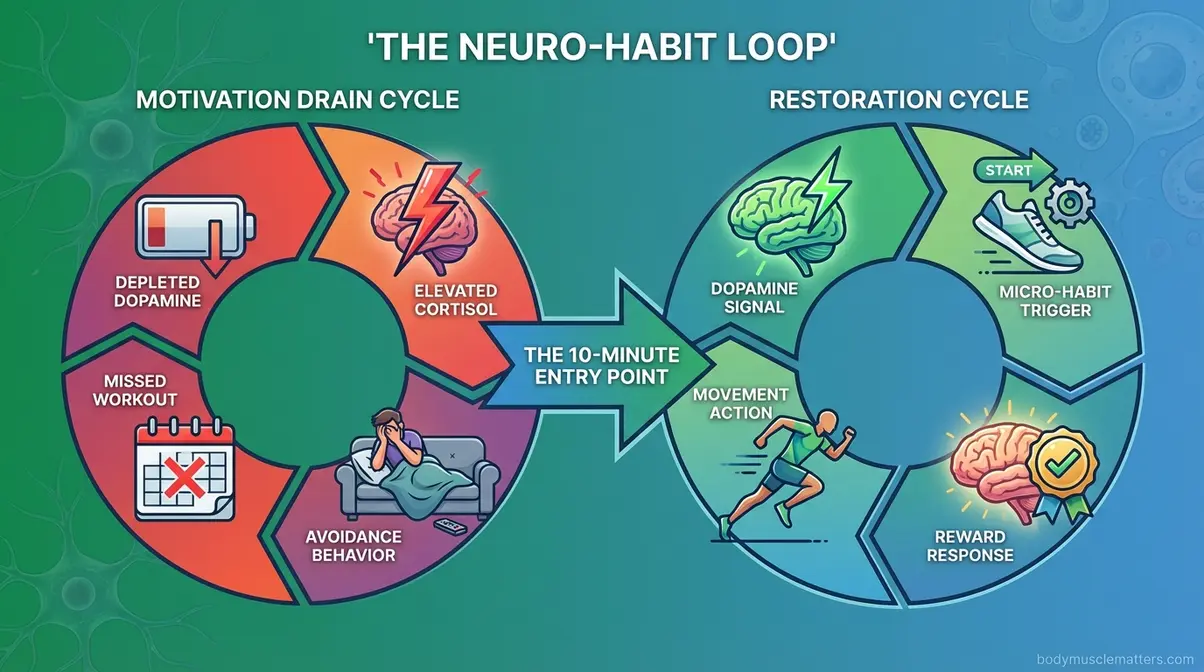
Caption: The Neuro-Habit Loop shows exactly where the motivation chain breaks — and the micro-habit entry points where you can restore it.
Intrinsic vs. Extrinsic Motivation
How to find intrinsic motivation is the real question behind every failed gym routine. Intrinsic motivation means exercising because of how it makes you feel — more energized, less anxious, more capable. Extrinsic motivation means exercising for external validation: a before/after photo, a number on the scale, or approval from others.
The chart below shows the difference in plain terms — and explains why one approach sticks while the other burns out.
| Intrinsic Motivation | Extrinsic Motivation |
|---|---|
| “I exercise because it clears my head” | “I exercise because I want to lose 10 lbs” |
| “Moving my body reduces my gym anxiety” | “I exercise to look better for an event” |
| “I feel stronger, so I keep going” | “I exercise because my doctor told me to” |
Research consistently supports this distinction: the role of intrinsic motivation in exercise adherence is highly predictive of long-term consistency, while extrinsic motivation produces short-term compliance that collapses when external rewards stall (National Institutes of Health, 2026). If you’ve quit gym routines before, there’s a good chance you were exercising for someone else’s version of your body — not for how your body feels.
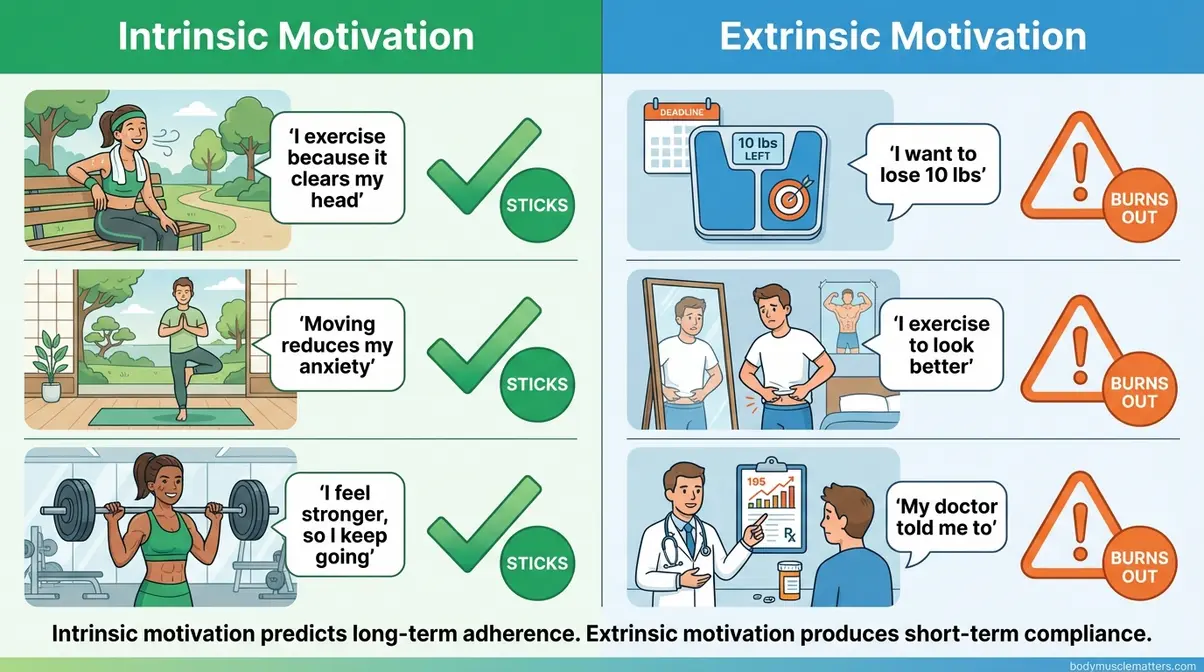
Caption: Intrinsic motivators create a self-reinforcing cycle; extrinsic motivators rely on external conditions staying constant — which they rarely do.
Why Willpower Is the Wrong Tool
The biggest motivation killer isn’t laziness — it’s relying on willpower to override a depleted system. Willpower is subject to decision fatigue (the mental exhaustion from making too many choices in a day). By 7 PM on a typical Tuesday, you’ve already made hundreds of micro-decisions. Asking your willpower reserve to then fuel a gym session is the neurological equivalent of expecting a phone on 2% battery to run a video call.
The alternative is the Neuro-Habit Loop: systems — pre-decided rules and micro-habits that activate automatically, so you don’t have to feel motivated to start. You don’t decide whether to brush your teeth each night — you just do it. The goal is to make exercise feel the same way.
Immediate Strategies to Get Moving
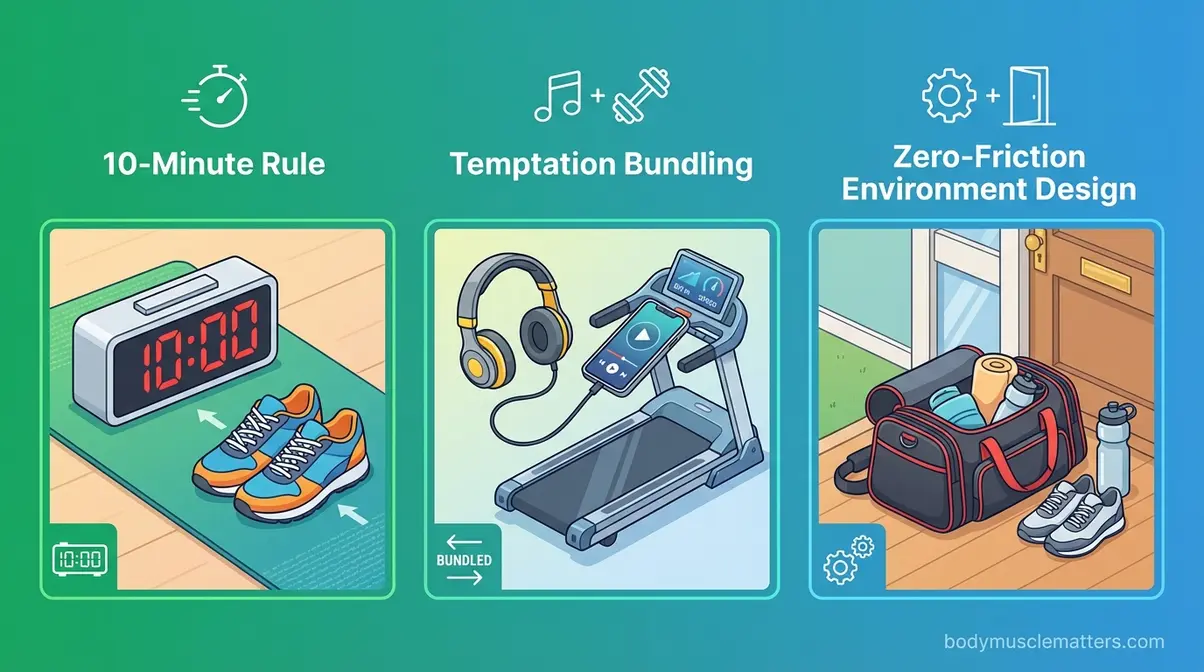
When you’re trying to find motivation to exercise on your worst days, abstract advice makes everything worse. What you need are specific, behavioral tactics with a fast on-ramp.
CDC guidelines on overcoming common fitness barriers identify the three most common obstacles to physical activity as lack of time, lack of energy, and lack of motivation (CDC, 2026). Each has a specific, behaviorally tested countermeasure. Each of these tactics below is also designed to activate the Neuro-Habit Loop by reducing the activation energy your brain needs to get started — so the first move costs you almost nothing.
Use the flowchart below as your daily decision guide — especially on the days that feel impossible.
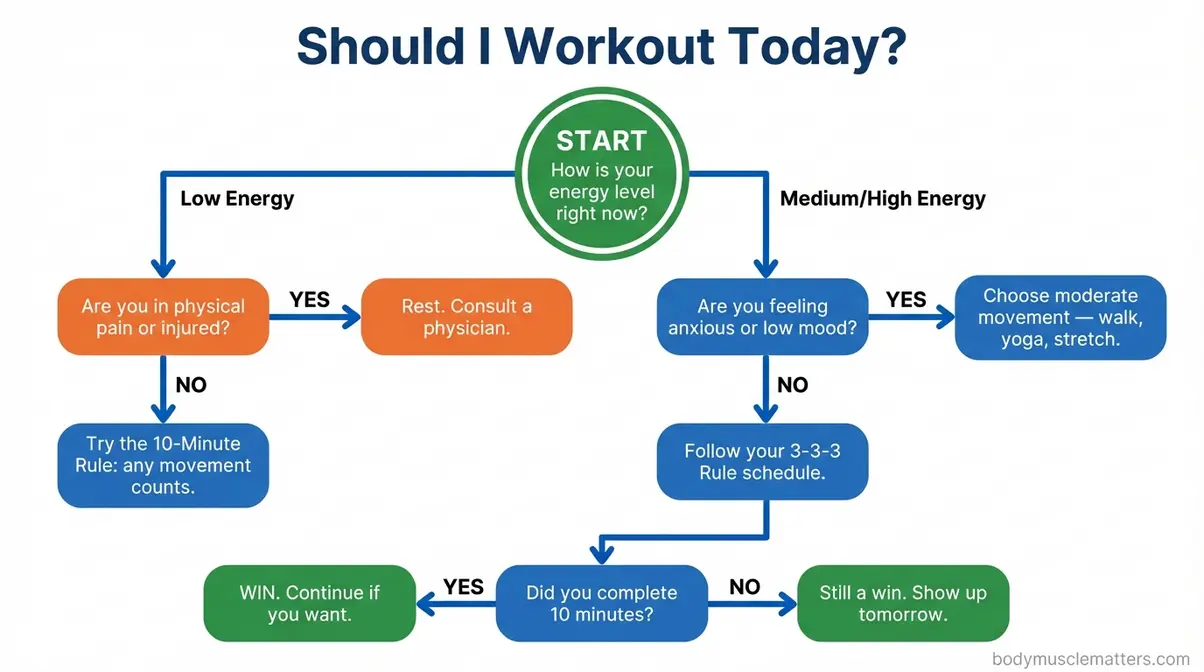
Caption: Run through this flowchart before skipping a workout — it accounts for both energy levels and mental health state to give you a personalized next step.
Here are the three tactics that work — starting with the one that takes less than a minute to decide.
Should I Workout Unmotivated?
If you’re wondering how to find motivation to workout when you can barely get off the couch, the 10-Minute Rule is your answer. The rule is simple: commit to just 10 minutes of any movement — a walk, light stretching, a few bodyweight squats. If you still want to stop after 10 minutes, stop. You’ve already won.
Here’s why it works: starting is the hardest neurological step. Your brain resists unfamiliar or high-cost activation energy. Once you are physically moving, dopamine begins to signal reward, making continuation easier — not harder. That’s the momentum principle at the core of the Neuro-Habit Loop. The 10-Minute Rule deliberately sets the bar low enough to bypass your brain’s avoidance reflex entirely.
The answer to whether you should workout when unmotivated is: yes — but radically lower your standard. A 10-minute walk is a workout. A crappy half-assed session is infinitely better than no session. You’re not cheating the system; you’re using it correctly.
- Your 10-Minute Rule setup:
- Put on workout clothes (or shoes)
- Set a timer for 10 minutes
- Begin — anything counts
If you stop at 10 minutes, that’s a win. If you keep going, that’s the dopamine system working exactly as intended.
Temptation Bundling Strategies
One of the most effective ways to motivate yourself to exercise is to stop making it feel like a chore. Temptation Bundling, a behavioral strategy developed by Dr. Katy Milkman (behavioral economist, University of Pennsylvania), means pairing something you want to do with something you need to do.
The results are striking. In Milkman’s original research, participants in the temptation bundling group visited the gym 51% more frequently than the control group during a 10-week study — simply by restricting access to compelling audiobooks to gym visits only (PMC, NIH). The neurological reason: pairing exercise with an immediate reward triggers a dopamine response before and during the workout, reducing your brain’s perceived cost of starting.
- Here’s what this looks like in practice:
- Only listen to your favorite podcast during workouts
- Only watch your guilty-pleasure Netflix show while on the treadmill
- Save your favorite playlist exclusively for gym sessions
If you’re in your lazy girl era and the gym feels impossible, this is the tactic: attach one thing you love to the workout. The post-workout high does the rest. As the NYT guide on habit-based motivation confirms, temptation bundling is among the most evidence-backed strategies for building lasting workout habits (New York Times, 2026).
Zero-Friction Environment Design
Every step between you and exercise is a friction cost that depletes motivation before you’ve even started. Finding your gym bag, choosing a workout, deciding when to go — each micro-decision is a small neurological drain that compounds into “I’ll go tomorrow.”
Environment design is the practice of removing every unnecessary decision between you and your workout. Here are five specific friction-reduction moves:
- Put your gym bag by the door the night before (removes the “pack it” decision entirely)
- Lay out your workout clothes before bed (eliminates the “what do I wear” barrier)
- Schedule a specific time — not “morning” but “7:15 AM Monday” — into your calendar
- Create a 5-minute launch ritual (coffee → shoes → go) to trigger automatic behavior
- If you’re doing home workouts: designate a specific corner or room so your brain associates that space with movement
Every friction point you remove is one less activation energy cost — which means more dopamine available to actually start. This environment design approach is one of the most reliable ways to keep yourself motivated to exercise without relying on ever feeling “ready.”
⚠️ Health Disclaimer: The information in this section is for educational purposes only and is not a substitute for professional medical advice, diagnosis, or treatment. If you are experiencing symptoms of clinical depression, severe anxiety, or chronic fatigue, please consult a licensed physician or mental health professional before beginning or modifying an exercise routine.
Depression and Anxiety Barriers

If you are trying to figure out how to find motivation to workout when depressed, anxiety-ridden, or chronically exhausted, the standard “just push through it” advice isn’t just unhelpful — it can make things worse. Physical inactivity and low energy are strongly linked to depressed moods, while increasing daily physical activity can significantly reduce symptoms of depression, per NIH findings on physical activity and depression symptoms (NIH, 2026). Here’s the science — and a gentler approach that meets you where you are.
Exercise is one of the most effective treatments for depression — but depression is one of the strongest barriers to exercise. The goal of this section is to shrink that gap.
How Does Exercise Reduce Cortisol?
Regular moderate exercise — such as 30 minutes of walking or jogging daily — has been shown to reduce baseline cortisol levels over time, training the central nervous system to handle stress more efficiently (Stanford Lifestyle Medicine, 2026). This is the cortisol answer: not more intensity, but consistent, manageable movement.
Here is the nuance that most fitness content misses entirely. High-intensity workouts temporarily spike cortisol — which is why someone with high anxiety or depression who forces themselves through an intense gym session may feel worse afterward, not better. This is not a failure of effort; it is a physiological response. Stanford research on exercise and baseline cortisol confirms that moderate exercise specifically — not extreme exertion — is what drives the long-term cortisol reduction that improves mood, energy, and motivation (Stanford Lifestyle Medicine, 2026). A systematic review on lowering cortisol levels published in a peer-reviewed journal further confirmed that physical activity significantly reduces cortisol and improves sleep quality (NIH, 2026).
The practical prescription from this research is clear: start with moderate intensity — a brisk walk, a slow jog, yoga, swimming — not a punishing HIIT session. The goal is to train your nervous system, not overwhelm it.
The Athletic Burnout Triad explains why so many motivated beginners flame out: the cycle of overtraining, cortisol overload, and motivational collapse that appears when people push too hard too fast. You feel low energy, force an intense workout to “jumpstart” yourself, spike your cortisol, feel worse, and quit. Moderate movement breaks the triad before it starts.
Reframe Exercise as Movement
When you have no motivation and no energy, the word “exercise” itself carries too much weight. It implies performance, standards, intensity — all of which raise the activation energy threshold and make skipping feel rational.
The all-or-nothing mindset says: if you can’t do a full 45-minute session, there’s no point. This is one of the most reliable motivation killers in existence. It makes doing nothing feel logical. The fix is linguistic and psychological: swap “exercise” for “movement.”
Movement is exercise. A walk counts. Stretching counts. Getting up counts.
A 10-minute walk, dancing in your kitchen, 5 minutes of stretching, or taking the stairs — none of it is a crappy half-assed workout. All of it is your Neuro-Habit Loop activating. The reason reframing exercise as “movement” works is because it lowers the activation energy threshold of the Neuro-Habit Loop — you’re not asking your depleted dopamine system to power a marathon, just a walk. Exercise as a therapeutic intervention for depression has been validated as a powerful modality for Major Depressive Disorder (MDD) — a clinical condition involving persistent depressive symptoms that go beyond a normal low-energy slump — with research showing it can prevent and treat depressive symptoms even at low intensities (NIH, 2026).
When to Seek Professional Support
Some situations go beyond what a motivation guide can address. Consult a licensed physician or mental health professional if you notice any of the following:
- Persistent low mood lasting more than two weeks that doesn’t improve with any movement
- Exercise aversion accompanied by hopelessness, significant sleep changes, or appetite changes (possible symptoms of clinical depression)
- Severe anxiety that makes public exercise spaces — gyms, parks, even sidewalks — feel unsafe
Exercise science supports physical activity as a complement to clinical treatment — not a replacement. NIH findings on physical activity and depression symptoms are clear: physical activity can significantly reduce depression symptoms and is increasingly used alongside clinical treatment, but professional guidance is essential for severe symptoms (NIH, 2026). Please don’t use this guide as a substitute for that guidance.
The 3-3-3 Rule for Long-Term Habits

Once you’ve addressed the immediate motivation barrier, the challenge shifts: how do you stay motivated to exercise past the first two weeks? The answer is structure — specifically, a structure that removes daily decision-making about how much to do. One of the most underrated friction costs in long-term consistency is deciding your workout plan from scratch every morning. The 3-3-3 Rule solves that.
The 3-3-3 Rule is a balanced weekly workout framework: 3 days of strength training, 3 days of cardio, and 3 days of active recovery. That’s your entire week, accounted for with zero ambiguity. No decision fatigue, no skipped days from overthinking. Each of these three categories reinforces the Neuro-Habit Loop in a different way — strength builds competence, cardio elevates mood via endorphin release, and recovery keeps cortisol from spiking into burnout territory.
What Is the 3-3-3 Rule for Workout?
Here’s what a 3-3-3 week looks like in practice:
| Day | Focus | Example |
|---|---|---|
| Monday | Strength | Bodyweight squats, push-ups, resistance bands |
| Tuesday | Cardio | 30-min brisk walk or easy cycling |
| Wednesday | Active Recovery | Gentle yoga, stretching, or a slow walk |
| Thursday | Strength | Dumbbells, gym machines, or calisthenics |
| Friday | Cardio | Swimming, jogging, or a dance class |
| Saturday | Strength | Full-body circuit or barbell work |
| Sunday | Active Recovery | Foam rolling, leisurely hike, or rest |
Why does this balance work? Strength days build the sense of physical competence that feeds intrinsic motivation. Cardio days improve cardiovascular function and reduce baseline cortisol over time. Active recovery days prevent the Athletic Burnout Triad — overtraining is one of the fastest ways to crater motivation, and scheduled rest removes the guilt of taking it. You’re not skipping; you’re following the plan.
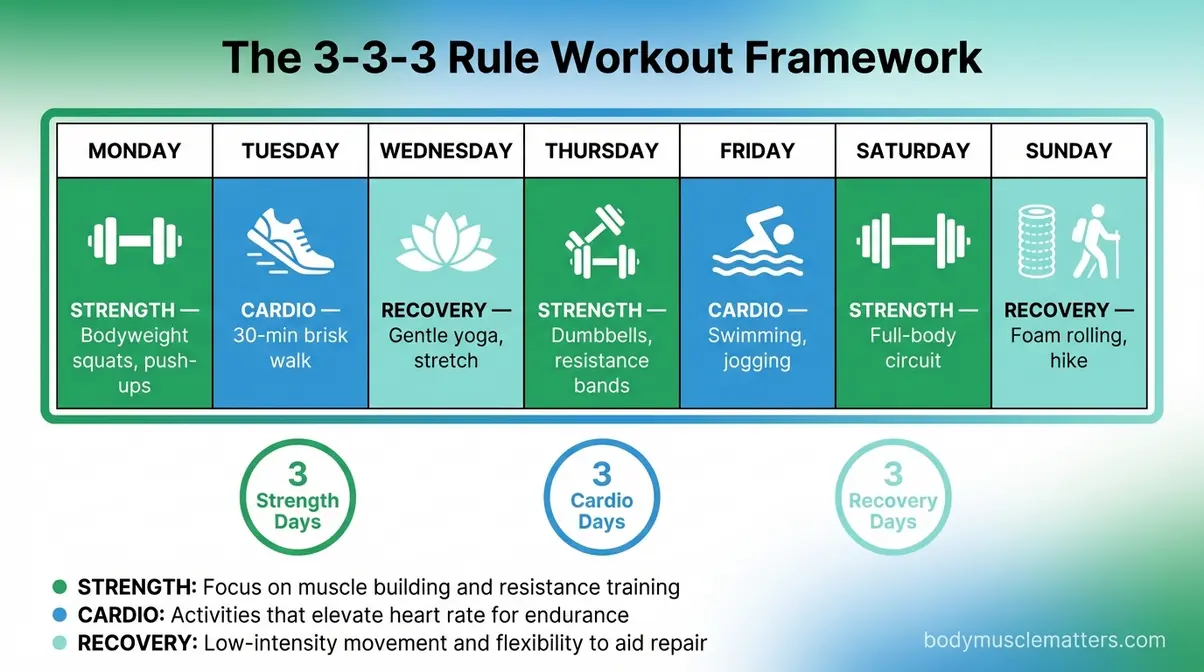
Caption: The 3-3-3 Rule gives every day of the week a clear purpose — removing the “what should I do today?” decision that kills momentum.
Tracking and Accountability
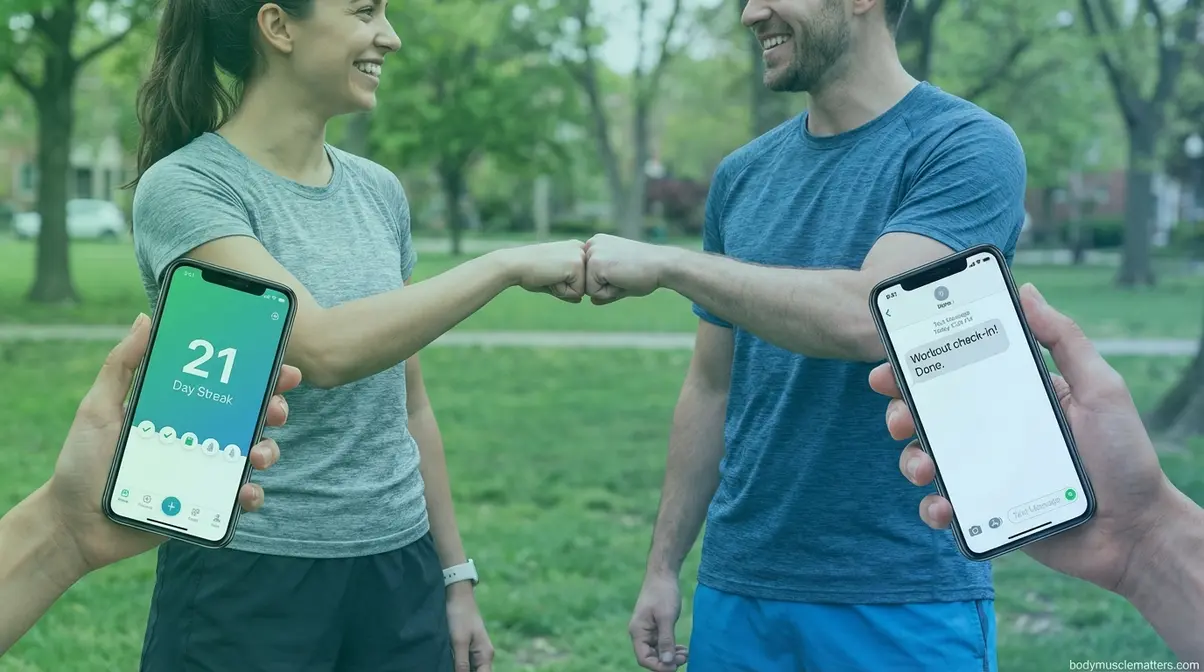
Knowing the plan is one thing. Building the habit is another. A 2026 meta-analysis of 42 studies found that structured accountability systems make individuals 2.8x more likely to maintain habits long-term — and habits that are actively tracked are 2.5x more likely to persist than those that aren’t (Coach Pedro Pinto, citing meta-analysis, 2026). These are not small margins.
Two methods that work:
Habit tracking apps (Streaks, Habitica, or even a paper calendar) give your brain a visual reward for consistency. The simple act of marking off a day activates a small dopamine response — which reinforces the behavior. The key: track the habit (did you move today?), not the performance (did you hit a PR?). This keeps the bar accessible on low-energy days.
Accountability partners compound the effect. Knowing someone else is checking in shifts exercise from a private intention to a social commitment. Research cited by the Journal of Behavioral Medicine found that dyadic (one-on-one) accountability increased habit adherence by 37% over 12 weeks compared to solo tracking. To ask effectively: be specific. Don’t say “want to work out together?” Say “Can I text you every Monday, Wednesday, and Friday after my workout this month?” A specific ask gets a specific yes — and a specific commitment.
Step Tracking and Mindfulness
A 2026 University of Bath study offers one of the most practical emerging frameworks for long-term exercise motivation: combining step tracking with a daily mindfulness practice significantly boosts the intention to keep exercising — which is the strongest predictor of actual behavior change. Participants using both step tracking and a daily mindfulness app logged approximately 373 minutes of moderate exercise per week, compared to 297 minutes for the step-tracking-only group (University of Bath, 2026).
The mechanism: mindfulness builds body awareness and self-compassion, which reduces the harsh self-judgment that follows a missed workout. When skipping doesn’t spiral into “I’ve ruined everything,” it’s far easier to restart the next day. Pair a basic step-tracking app (your phone’s native Health app works) with 5 minutes of guided breathing before your workout — and your Neuro-Habit Loop gains a psychological anchor that pure willpower never provides.
How to Motivate Someone Else
Watching someone you care about struggle with inactivity — and not knowing how to help — is its own particular frustration. The instinct is to encourage, but the delivery matters enormously.
The most important rule: lead with curiosity, not prescription. Telling someone they should exercise often triggers defensiveness and backfires. Instead, ask what kind of movement they used to enjoy, or what physical activity sounds even slightly appealing. The goal is to find a low-pressure entry point they’re willing to try — not the “optimal” workout you think they should do.
Second, offer proximity over advice. Inviting someone to walk with you, cook a healthy meal together, or try a low-stakes activity like paddleboarding or a beginner yoga class is more effective than a lecture. Exercise science consistently shows that social context reduces gym anxiety and lowers the activation energy threshold for beginners. You become the friction-reducing environment for someone else.
Social accountability increases habit adherence by up to 40% — making a supportive partner infinitely more effective than a demanding drill sergeant.
Finally, avoid tying encouragement to appearance. “You’ll look great” focuses attention on extrinsic motivation — the type that collapses under pressure. Instead: “I always feel less anxious after we walk together” keeps the focus on how it feels, which is the intrinsic hook that actually sticks. Offer to track simple daily wins together without pressure.
Applying Principles to Daily Life
The Neuro-Habit Loop isn’t exclusive to the gym. The same dopamine-cortisol dynamic that drains your exercise motivation is responsible for the 3 PM slump that makes your inbox feel impossible, the procrastination spiral before a difficult assignment, and the general inertia of a stressful season.
The principles transfer directly. Apply the 10-Minute Rule to any avoided task: commit to just 10 minutes of work on the thing you’re avoiding. Set a timer. Stop if you need to. Most of the time, you won’t. Tasks with low activation energy are significantly more likely to be completed — proving that reducing friction beats relying on sheer discipline every time.
Use environment design at your desk: close tabs, set your workspace the night before, establish a “launch ritual” before deep work. Apply temptation bundling to study sessions — allow yourself a specific podcast or playlist only during focused work blocks.
How to find motivation to work follows the same neurological logic as how to find motivation to exercise: lower the activation cost, reduce friction, and let the Neuro-Habit Loop do the rest. Once you understand that motivation is an output rather than a prerequisite, you stop waiting to feel ready — and start creating the conditions that make readiness happen automatically. You can build these micro-habits into your morning routine to guarantee early wins.
Limitations and Common Pitfalls
Common Mistakes to Avoid
Even the best framework fails when applied incorrectly. Here are the most consistent pitfalls:
Starting too intense: The most common mistake is beginning with a punishing routine. Three days in, cortisol spikes, soreness sets in, and motivation collapses — exactly the Athletic Burnout Triad described in H2 3. Start at 40% of what you think you can do. Sustainability, not impressiveness, is the goal in the first month.
Relying on motivation to show up first: Motivation follows action — it doesn’t precede it. Waiting until you “feel like it” inverts the neurological sequence. The Neuro-Habit Loop is designed to get you moving before you feel ready, because movement is what produces the feeling.
Treating missed days as failure: Missing one workout does not break a habit. Research on habit formation consistently shows it is the response to a missed day — not the miss itself — that determines long-term outcomes. Restart the next day without negotiation or guilt.
Ignoring recovery: Over-scheduling is as damaging as under-scheduling. Rest days are not weakness — they are when muscular repair and cortisol regulation occur. The 3-3-3 Rule builds recovery in deliberately for this reason.
When to Choose a Different Approach
The Neuro-Habit Loop and the tactics in this guide work best for people experiencing situational demotivation — a slump driven by stress, routine disruption, or habit gaps. They are not sufficient as standalone interventions for:
- Clinical depression or anxiety disorders: If symptoms meet the indicators described in the “When to Seek Professional Support” section, please consult a licensed mental health professional. Exercise is a powerful complement to treatment, not a replacement.
- Chronic pain or injury: If physical discomfort is driving exercise avoidance, the right first step is a physician or physical therapist — not a 10-minute rule.
- Severe burnout: If you are experiencing complete emotional and physical exhaustion, the priority is rest and professional support, not adding more habits to manage.
Frequently Asked Questions
Why Do I Lack Motivation?
Low exercise motivation is most often a neurological issue, not a personal failing. When dopamine — the brain chemical responsible for initiating action — is depleted by chronic stress, poor sleep, or overwork, your brain stops signaling that exercise is “worth doing.” Cortisol compounds this by shifting the brain into avoidance mode. The fix isn’t more willpower — it’s restoring the neurochemical conditions that make starting feel possible.
What Is the Biggest Motivation Killer?
The biggest motivation killer is relying on willpower to override a depleted neurochemical system. Willpower is subject to decision fatigue — it diminishes throughout the day with each choice you make. By the time most people plan to work out, their willpower reserve is nearly empty. Compounding this with high-intensity exercise goals or all-or-nothing expectations makes quitting feel inevitable. The solution is systems over willpower: pre-decided habits, low activation costs, and environmental design that makes starting automatic rather than effortful.
Root Cause of Motivation Lack?
The root cause of lack of motivation is typically a combination of dopamine depletion and chronic cortisol elevation — both of which are physiological, not character-based. When your brain’s reward anticipation system (dopamine) runs low and your stress response system (cortisol) runs high, the effort-to-reward calculation tips against starting any demanding task. Research from the University of Pennsylvania identifies a disconnection from meaningful purpose as a further driver — making the energy expenditure feel unworthy. Understanding this mechanism changes the intervention from “try harder” to “restore the conditions that make trying feel worth it.”
Is Doing 3 Workouts a Week Enough?
For most beginners, 3 workouts per week is not just enough — it is optimal. The American College of Sports Medicine recommends 150 minutes of moderate-intensity physical activity per week, which 3 sessions of approximately 50 minutes comfortably covers. More importantly, 3 sessions per week allows for adequate recovery between efforts, preventing the cortisol-spiking overtraining that leads to burnout and dropout. The 3-3-3 Rule builds on this foundation by adding variety (strength, cardio, recovery) to prevent monotony — one of the top drivers of long-term exercise avoidance.
Best Approach for Lasting Motivation?
The most evidence-supported approach combines the 3-3-3 Rule with step tracking and a daily mindfulness practice. A University of Bath study (2026) found that participants using both step tracking and mindfulness logged significantly more weekly exercise minutes and reported stronger intentions to keep going long-term. The mindfulness component builds the self-compassion that prevents one missed workout from becoming a month-long absence. Pair this with intrinsic goal-setting — exercising for how movement makes you feel, not for how you want to look — and you have a framework that doesn’t require willpower to sustain.
Building the Habit That Lasts
For anyone who has spent months waiting for motivation to arrive before starting, the Neuro-Habit Loop reframes the entire conversation. Exercise motivation is not a prerequisite — it is a product. When you engineer your environment, lower your activation costs, and start with 10 minutes instead of 60, your brain’s dopamine system does the rest. Research supports this at every level: from intrinsic motivation predicting long-term adherence (NIH, 2026) to moderate exercise reducing baseline cortisol over time (Stanford Lifestyle Medicine, 2026) to accountability partners increasing habit consistency by 37% (Journal of Behavioral Medicine).
The Neuro-Habit Loop is the through-line connecting everything in this guide. Lower the cost of starting. Remove the friction between you and movement. Pair the behavior with something rewarding. Track the streak, not the performance. Over time, the system does what willpower never could — it makes exercise feel inevitable rather than heroic.
Your next step is simpler than you think: put on your shoes. Set a timer for 10 minutes. Move. That’s the entire system in its smallest form — and it’s enough to start rewriting the neurological story you’ve been telling yourself. The 3-3-3 Rule, the accountability partner, the mindfulness practice — those come later. Right now, 10 minutes is everything.
Related posts:
Benefits of Yoga for Fitness: The Science-Backed Guide
Home Workouts to Build Muscle Without Weights (2026)
CrossFit Strength Training for Beginners: 2026 Guide
Home Workout Plan for Beginners: 30-Day Step-by-Step
How to Self Massage Calves: The 4-Layer Method Guide
Strength Training for Beginners: Complete Workout Plan 2026

Callum
Hi, I'm Callum, the founder of Body Muscle Matters. I'm not a certified trainer, I'm a self taught lifter who started this site to share what I've learned from my own training and a lot of trial and error. Everything here comes from real experience and honest research, written the way I'd explain it to a friend who is just getting started. My goal is simple: practical, no hype fitness advice you can actually use.