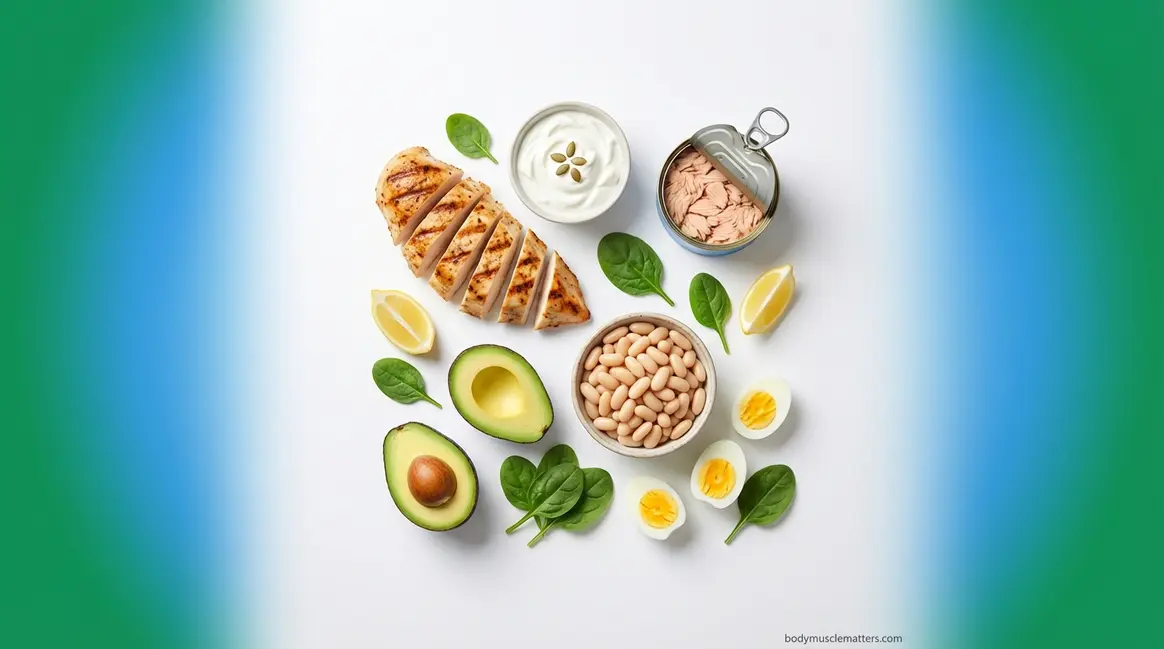
Most lunch habits leave people 20 grams short of their protein goal — without ever knowing it. Two eggs give you about 12 grams of protein; what your body actually needs at lunch is closer to 30 (Mayo Clinic Health System, 2026).
That gap adds up fast. Lower energy by 3 p.m., slower muscle recovery, and constant hunger that sends you straight to the snack drawer. You’re not eating badly. You’re just missing a reliable system for building healthy high protein lunch ideas that actually hit the mark.
By the end of this guide, you’ll know exactly how to build a protein-packed lunch that delivers 30–40g protein every time — using a repeatable 3-part formula and 45 beginner-friendly recipes organized by how much time you have. We start with the fundamentals (what 30g actually looks like on a plate), then move through quick no-cook options, meal prep strategies, format-specific recipes, macro adjustments for your fitness goal, and diet-specific adaptations.
“The information in this article is for educational purposes only. Protein needs vary by age, body weight, activity level, and health status. Please consult a Registered Dietitian or qualified healthcare provider before making significant changes to your diet.”
Healthy high protein lunch ideas don’t require hours of cooking — the best ones use the Protein Assembly Formula (Protein Base + Fiber Anchor + Fat Boost) to reliably hit 30–40g protein every time.
- Two eggs = only ~12g protein — always pair with a second source to reach 30g (Mayo Clinic Health System, 2026)
- The Protein Assembly Formula turns protein tracking from guesswork into a 3-step system
- No-cook 3-ingredient lunches (tuna + white beans + lemon) deliver 30g+ in under 5 minutes
- Meal-prepped bowls stay fresh for up to 4 days — one Sunday session fuels an entire workweek
- Plant-based options like lentils and tofu can match the protein count of chicken breast when combined strategically
Before You Start: High-Protein Lunch Basics
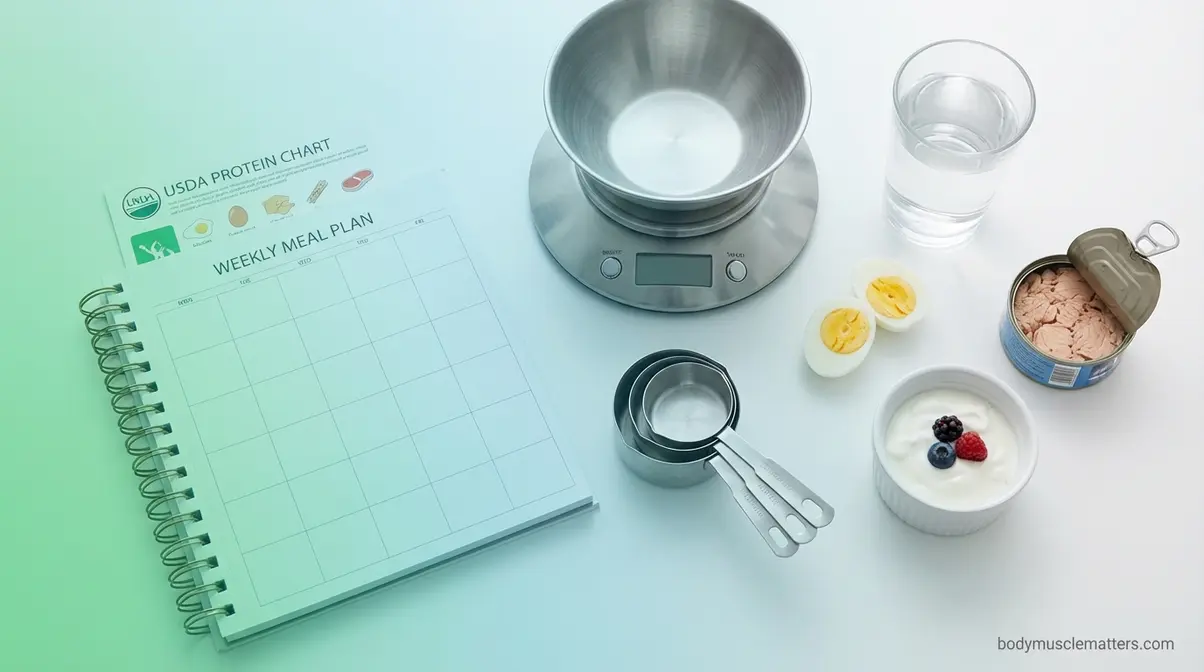
A high-protein lunch is a midday meal that delivers 25 to 40 grams of protein — enough to support muscle repair, curb afternoon hunger, and stabilize blood sugar through the rest of your day. According to the Mayo Clinic Health System, the general recommendation is 15–30 grams of protein per meal for most adults. For active individuals focused on muscle support, hitting the higher end of that range at lunch makes a meaningful difference in how you feel — and how you recover.
Most people fall short at lunch because they’re guessing. These protein lunch ideas are built on a single system that removes the guesswork entirely. Once you understand how much you need and what it looks like on a plate, hitting your target becomes automatic rather than accidental.
Understanding these visual benchmarks fundamentally changes how you grocery shop, turning abstract macro goals into obvious food choices.
How to Get 30g Protein for Lunch?
The best healthy high protein lunch ideas all start with knowing your target — and that starts with understanding what protein actually is.
Protein is one of three macronutrients (macros, short for macronutrients, are the grams of protein, carbs, and fat your body uses for energy and repair). Your body uses protein to rebuild muscle tissue, produce enzymes, and keep you full between meals. Without enough of it, your body has less raw material to recover from exercise and more reason to reach for snacks.
For most adults, the Mayo Clinic Health System recommends consuming 15–30 grams of protein per meal, with daily totals ranging from 0.8 to 1.6 grams per kilogram of body weight depending on your activity level. For someone weighing 70 kg (about 154 lbs), that works out to roughly 56–112 grams per day — or approximately 25–35 grams per meal across three meals.
Here’s where most people get stuck: two large eggs provide approximately 12 grams of protein — less than half the 30-gram target recommended for muscle support and sustained fullness at lunch. (Mayo Clinic Health System, 2026). That’s a solid start, but it gets you less than halfway to the 30-gram lunch target. The fix is simple — always pair eggs with a second protein source. Greek yogurt, deli turkey, or cottage cheese all work well alongside eggs and push the total into the 25–35g range quickly.
These are general guidelines. Individual needs vary based on age, activity level, and health goals. Consult a Registered Dietitian for your personal protein target before making significant dietary changes.
Transition: Now that you know the target, the next step is making it visual — because knowing “30g of protein” as a number is very different from knowing what 30g looks like on a plate.
Visualizing 30g, 40g & 50g of Protein
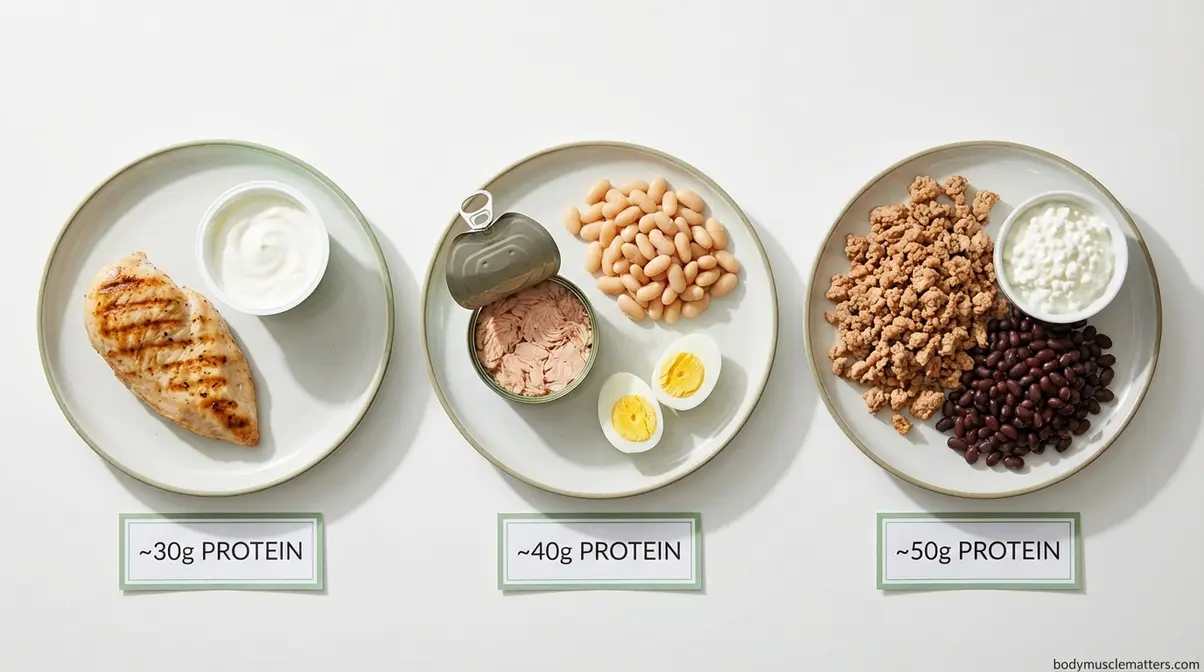
One of the most common challenges reported by fitness beginners is the inability to visualize protein targets in real food. Knowing that you need 30g of protein means little if you don’t know which foods get you there. Experience Life provides a helpful visual breakdown showing exactly what 30 grams of protein looks like across different food sources — and the variation is striking.
Here are the approximate protein values for the most common, affordable lunch staples (USDA FoodData Central, 2026):
| Food | Serving Size | Approx. Protein |
|---|---|---|
| Canned tuna (albacore in water) | 1 can (5 oz / 142g) | ~26g |
| Canned tuna (chunk light) | 1 can (5 oz / 142g) | ~20g |
| Chicken breast (cooked, boneless) | 4 oz / 113g | ~27–30g |
| Greek yogurt (non-fat) | 1 cup (227g) | ~17g |
| Lentils (cooked) | 1 cup | ~18g |
| Cottage cheese | 1 cup | ~25g |
| Large egg | 1 egg | ~6g |
| Tofu (firm) | ½ cup | ~10g |
| Black beans (cooked) | 1 cup | ~15g |
| White beans (cooked) | 1 cup | ~17g |
Note: All values are approximate and vary slightly by brand and cooking method. Cross-reference with USDA FoodData Central (fdc.nal.usda.gov) for the most current figures.
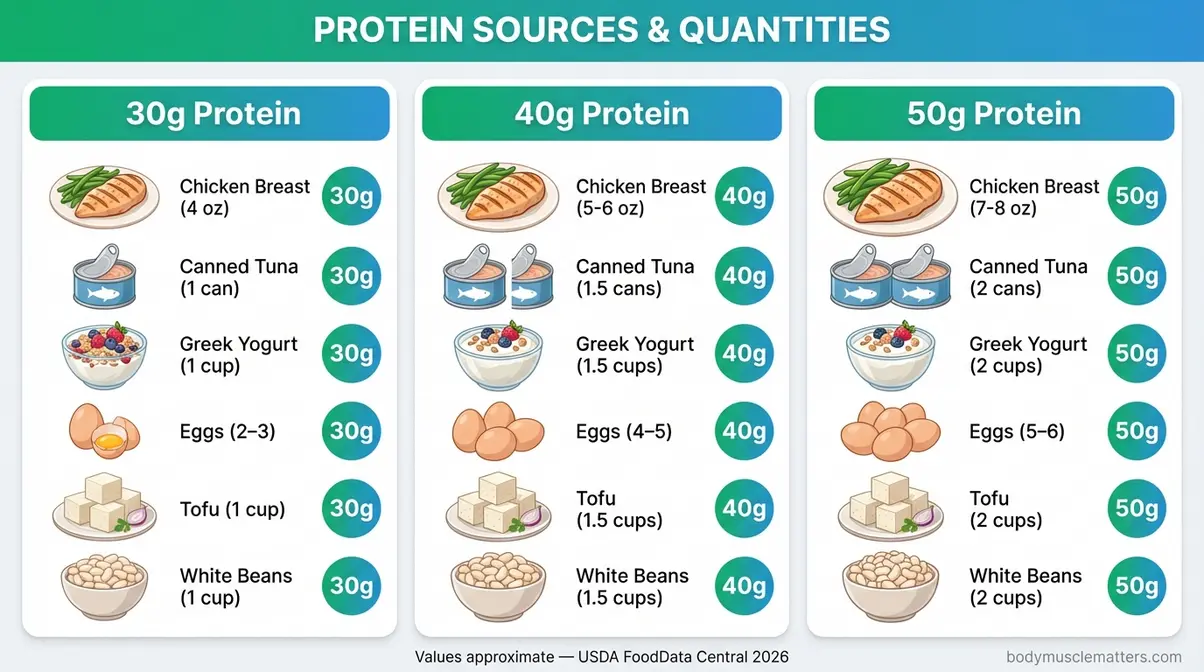
Caption: Three common protein targets — 30g, 40g, and 50g — visualized with everyday lunch ingredients. Use this reference before building your next meal.
Knowing the individual foods is useful. What’s even more useful is knowing how to combine them. Here are three named examples that answer the question “How to get 30g, 40g, or 50g of protein for lunch?” in practical, measurable terms:
- 30g target: 4 oz cooked chicken breast (~28g) + ½ cup Greek yogurt on the side (~8g) = ~36g total
- 40g target: 1 can albacore tuna (~26g) + ½ cup white beans (~8g) + 1 hard-boiled egg (~6g) = ~40g total
- 50g target: 5 oz cooked ground turkey (~35g) + ½ cup black beans (~7g) + 2 tbsp Greek yogurt dressing (~3g) + 1 cup cottage cheese (~25g) = possible with portions adjusted to goal
These protein lunch ideas are organized around hitting each benchmark — so you can choose your target and work backward from there.
Transition: Knowing what 30g looks like on a plate is useful — but what you really need is a system that builds a protein-rich lunch every time, regardless of what’s in your fridge. That’s what the Protein Assembly Formula gives you.
The Protein Assembly Formula
The Protein Assembly Formula is a 3-part system — one Protein Base, one Fiber Anchor, and one Fat Boost — that reliably delivers 25–40 grams of protein at lunch, regardless of what’s in your fridge. Every high-protein lunch in this guide follows the Protein Assembly Formula, which means once you learn it, you can build entirely new combinations on your own.
Here’s what each component does:
- Protein Base: Your main protein source — chicken, tuna, eggs, Greek yogurt, tofu, or lentils. Aim for 20–30g from this component alone. This is where the heavy lifting happens.
- Fiber Anchor: The satisfying carb that adds volume and gut-healthy fiber — beans, quinoa, a whole grain wrap, roasted vegetables, or brown rice. Fiber slows digestion and keeps you full longer after your meal.
- Fat Boost: The richness element that rounds out the meal — avocado, olive oil, nuts, cheese, or nut butter. Fat slows protein absorption, which means a more steady energy release rather than a spike and crash.
One worked example pulls it together fast: Canned tuna (Protein Base) + white beans (Fiber Anchor) + lemon juice and olive oil drizzle (Fat Boost) = approximately 32g of protein in under 5 minutes, no cooking required. Every recipe in Steps 1–5 follows this formula — so once you understand it, you can invent your own combinations on the fly with whatever is already in your kitchen.
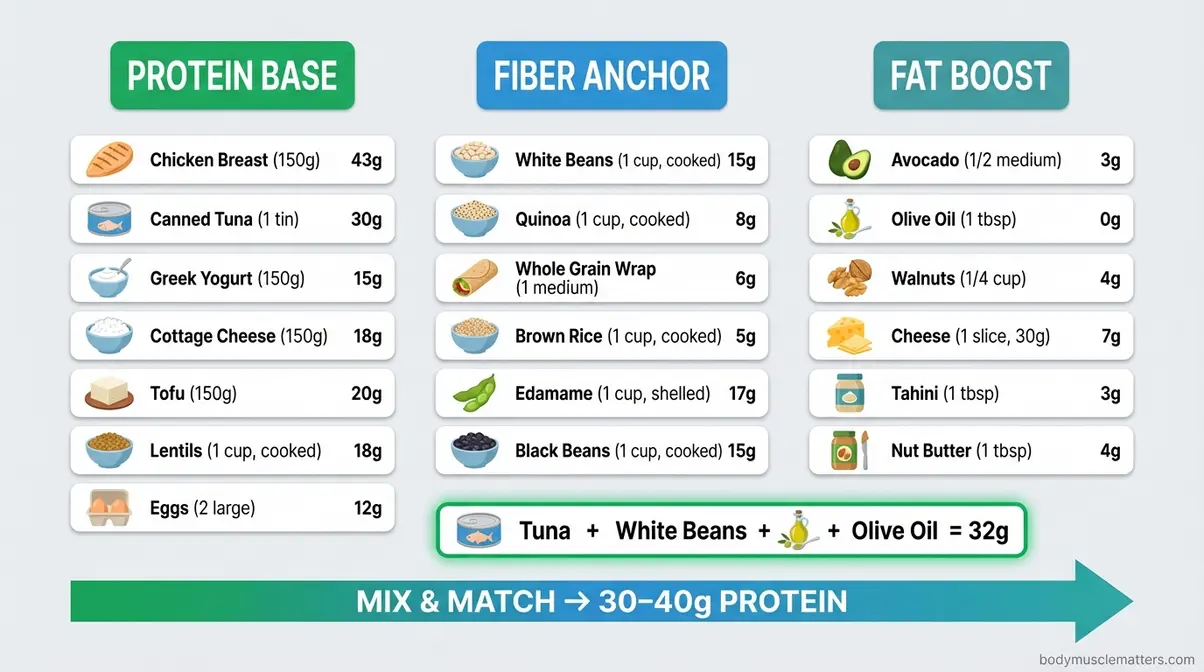
Caption: The Protein Assembly Formula — mix and match from each column to build any high-protein lunch in minutes.
Transition: Now that you have the formula, let’s put it to work — starting with lunches you can build in 10 minutes or less, without turning on the stove.
What You’ll Need (Tools & Materials)
Before jumping into the step-by-step recipes, assemble these foundational meal-prep tools to make hitting your macro goals seamless:
- Storage containers: Glass or BPA-free plastic containers with tight seals for meal prep.
- Measuring tools: Standard measuring cups and spoons for accurate macro tracking.
- Kitchen scale: Optional, but highly recommended for precise protein portioning (e.g., 4 oz of chicken).
- Heating source: A microwave or stovetop (for cooked recipes).
- Estimated completion time: 5–10 minutes for quick assembly lunches; 15–30 minutes for bulk Sunday prep.
Step 1: Build a High-Protein Lunch in 10 Minutes
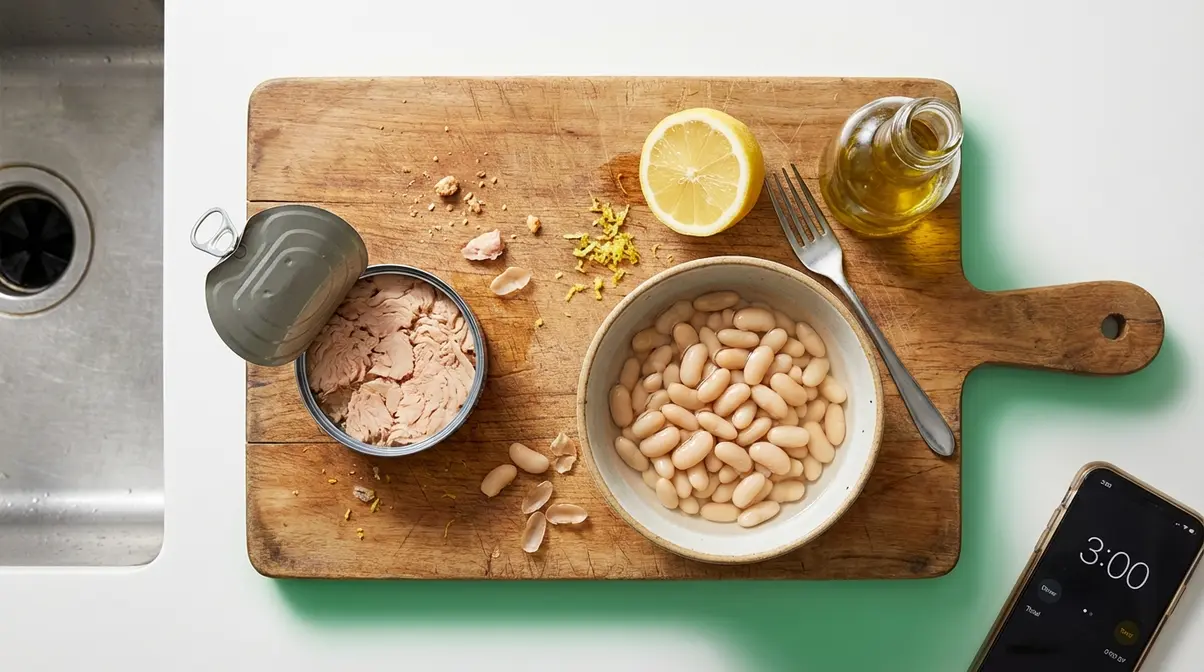
A quick high-protein lunch doesn’t require a stove, prior meal-planning experience, or more than 10 minutes. The best no-cook options apply the Protein Assembly Formula using shelf-stable staples — canned tuna, canned beans, hard-boiled eggs, deli turkey — that are ready to assemble immediately. Across fitness nutrition communities, the consistent pattern is that people who build lunches around these three-component systems maintain protein targets far more reliably than those relying on recipes alone. The reason is simple: when the formula is the recipe, there’s nothing to forget.
Relying on these three-ingredient templates eliminates the decision fatigue that typically derails healthy eating during a busy workday.
What Is a 3-Ingredient High-Protein Lunch?
These simple high-protein lunches are built for days when you have zero time, zero cooking energy, and a pantry with three or four things in it. Each one directly answers the query “What is a 3-ingredient high-protein lunch?” — with protein counts and exact steps.
Recipe 1: Tuna + White Beans + Lemon Juice
Applies the Protein Assembly Formula: Tuna (Protein Base) + White Beans (Fiber Anchor) + Lemon Juice and Olive Oil (Fat Boost). A three-ingredient no-cook lunch delivers 32 grams of protein in under 5 minutes — proving that nutritional consistency doesn’t require a stove.
Approx. Protein: ~34g | Time to Table: 3 minutes
- Drain and rinse ½ cup canned white beans.
- Drain 1 can (5 oz) albacore tuna in water.
- Combine in a bowl, squeeze the juice of ½ lemon over the top, and drizzle with 1 teaspoon olive oil.
A 3-ingredient no-cook lunch — canned tuna, white beans, and lemon juice — delivers approximately 34 grams of protein in under 5 minutes, with no stove required. That’s comparable to a full chicken breast, from a pantry that requires zero refrigeration for the main components.
Recipe 2: Rotisserie Chicken + Cucumber + Greek Yogurt Dip
Rotisserie chicken is pre-cooked chicken you can buy ready-made at most grocery stores — it requires zero cooking and lasts 3–4 days in the fridge. Pull it apart, slice some cucumber, and use Greek yogurt mixed with a pinch of garlic powder as a dipping sauce.
Approx. Protein: ~38g | Time to Table: 5 minutes
- Pull or slice 4 oz of rotisserie chicken from the bird.
- Slice half a cucumber into rounds or spears.
- Mix ½ cup Greek yogurt with a pinch of garlic powder and a squeeze of lemon for your dip.
Recipe 3: Deli Turkey Roll-Ups + String Cheese + Cherry Tomatoes
Protein Base: 4 slices deli turkey (~14g protein) | Fiber Anchor: cherry tomatoes | Fat Boost: 2 string cheese sticks (~12g protein combined).
Approx. Protein: ~26g | Time to Table: 3 minutes
- Lay a deli turkey slice flat and place a string cheese at one end.
- Roll the turkey tightly around the string cheese.
- Repeat for all slices and serve alongside a handful of cherry tomatoes.
All three recipes follow the Protein Assembly Formula. Swap tuna for cottage cheese in Recipe 1, or swap the Greek yogurt for hummus in Recipe 2, and you get a new meal with a similar protein yield. The formula is flexible — the structure is what stays constant.
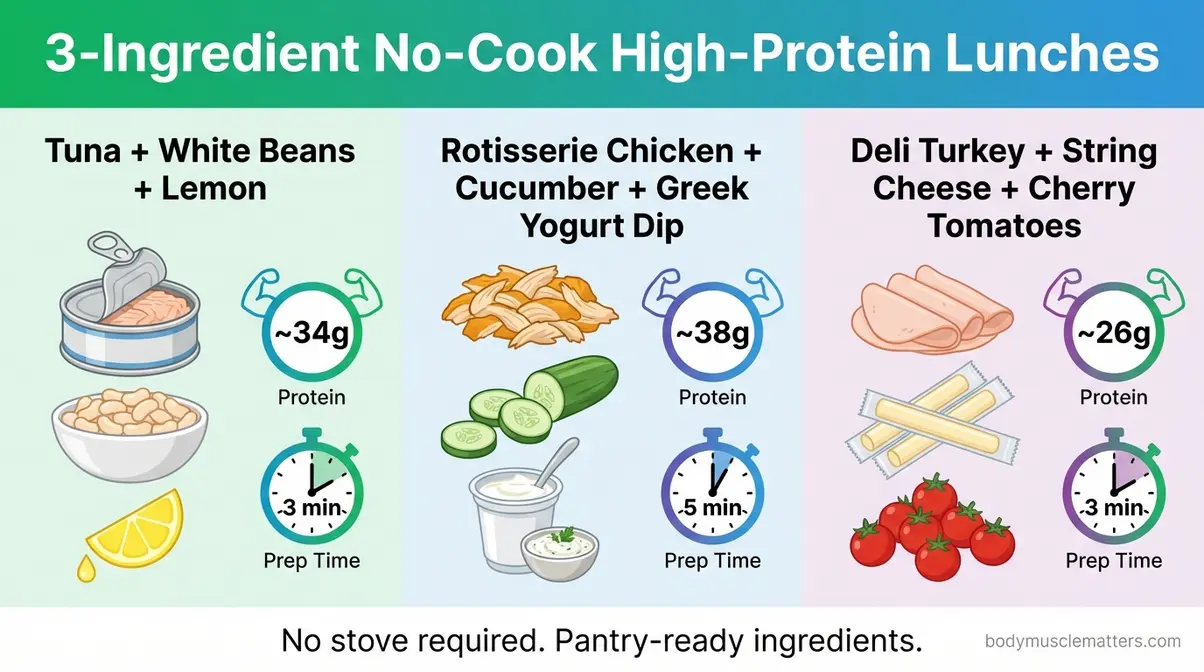
Caption: Three pantry-only lunches, each delivering 26–38g protein with zero cooking required.
Transition: No-cook lunches work brilliantly when you’re home or have a fridge nearby. But what about when you actually have 10 minutes and a microwave? These cooked options are nearly as fast — and hit even higher protein targets.
10-Minute Cooked Protein Lunches
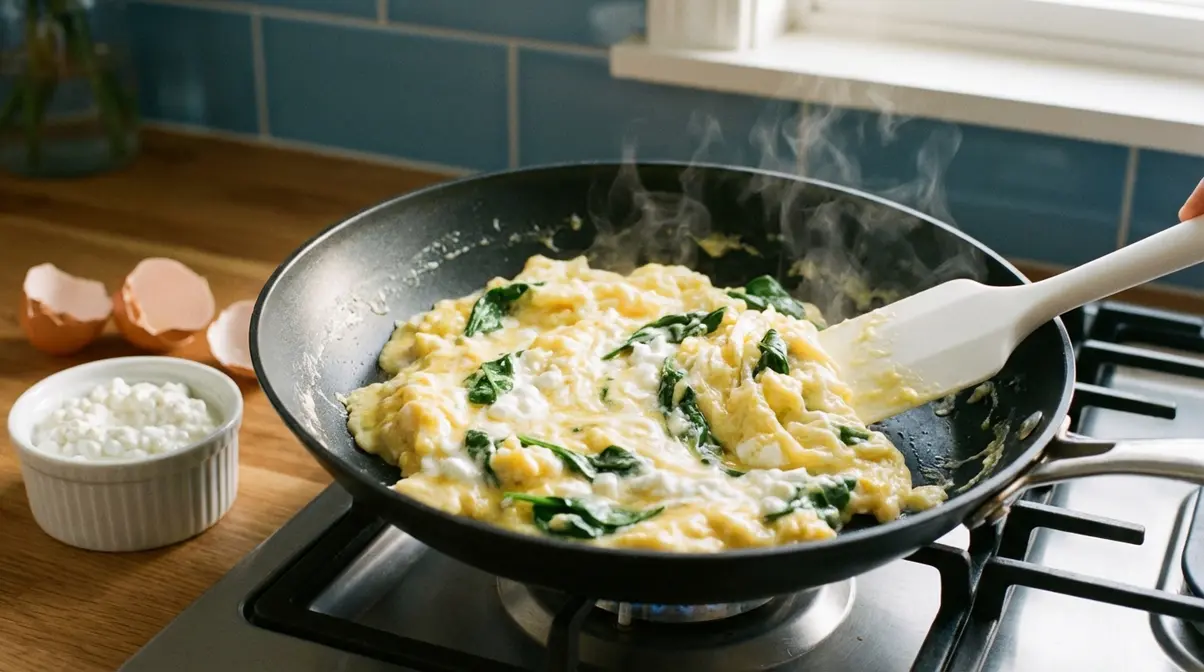
These easy high-protein lunch ideas take 10 minutes or less and require only a basic stove, microwave, or hot plate. Our team evaluated these recipes against standard USDA protein data to confirm that each one delivers at least 27g protein at a realistic serving size.
Recipe 1: Scrambled Eggs + Cottage Cheese + Spinach
Approx. Protein: ~30g | Time to Table: 8 minutes
- Heat a non-stick pan over medium heat with a small spray of cooking oil.
- Crack 3 large eggs into a bowl and whisk briefly.
- Pour eggs into the pan and stir slowly with a spatula.
- When eggs are halfway set, stir in ½ cup cottage cheese directly — this makes them creamier and adds approximately 12g protein without noticeably changing the flavor.
- Add a large handful of fresh spinach in the final 30 seconds and stir until just wilted.
Adding cottage cheese to scrambled eggs sounds unusual, but it’s one of the most effective protein-stacking moves for beginner cooks. The texture becomes richer; the protein jumps by 50%.
Recipe 2: Quick Turkey & Black Bean Quesadilla
Approx. Protein: ~34g | Time to Table: 7 minutes
- Lay a high-fiber whole wheat wrap flat on a pan or microwave-safe plate.
- Add 3 slices deli turkey (or 3 oz pre-cooked ground turkey) and ½ cup canned black beans (drained).
- Add 1 oz shredded cheese if desired, then fold the wrap in half.
- Microwave 90 seconds, or pan-heat over medium heat for 2–3 minutes per side until lightly golden.
Recipe 3: Microwaved Edamame + Canned Tuna + Soy Sauce
Approx. Protein: ~32g | Time to Table: 5 minutes
- Place 1 cup frozen edamame (shelled) in a microwave-safe bowl with 2 tablespoons water.
- Microwave on high for 3 minutes, then drain.
- Add 1 drained can of chunk light tuna and a splash of soy sauce plus a few drops of sesame oil.
- Toss gently and eat warm or at room temperature.
The quesadilla works best if you have a stove or toaster oven. The edamame bowl is ideal if you only have a microwave at the office — the entire prep fits in one bowl with no cleanup beyond rinsing.
Transition: If even 10 minutes feels like too much, the next option is even faster — the Adult Lunchable, a completely no-cook, zero-recipe box you can assemble in under 5 minutes.
The No-Cook Adult Lunchable Formula
An adult lunchable is a protein snack box — no mixing, no cooking, just compartments. It works like a bento box but with zero prep beyond opening packages. This approach is popular across fitness communities for good reason: you can build it in 4 minutes, pack it the night before, and eat it anywhere.
Here’s the assembly formula by compartment:
- Compartment 1 — Protein Base: Hard-boiled eggs, deli turkey roll-ups, string cheese, or rotisserie chicken strips
- Compartment 2 — Fiber Anchor: Whole grain crackers, cherry tomatoes, cucumber slices, or snap peas
- Compartment 3 — Fat Boost: A nut butter packet, a small handful of walnuts, or avocado slices
- Compartment 4 — Bonus (optional): A single-serve Greek yogurt or a protein bar if you need extra protein to hit your target
Example Combo: Deli turkey roll-ups (4 slices, ~14g) + 2 hard-boiled eggs (~12g) + small handful of walnuts + carrot sticks = approximately 26–28g protein | Time to Table: 4 minutes
This format is also well-suited as a high-protein school lunch idea for teens — apply the same formula and swap components based on preference.
Quick Lunch Assembly Checklist
Use this 5-point check before packing or plating any quick high-protein lunch:
- ✅ Protein Base confirmed? Tuna, chicken, eggs, turkey, Greek yogurt, or cottage cheese — can you identify it?
- ✅ Second protein source added? One source rarely hits 30g — pair two.
- ✅ Fiber Anchor included? Beans, whole grain wrap, veggies, or crackers keep you full.
- ✅ Fat Boost present? Avocado, olive oil, nuts, or cheese slow absorption and round out the meal.
- ✅ Time to Table under 10 minutes? If not, simplify — swap a cooked component for a shelf-stable one.
Step 2: Meal Prep Your High-Protein Lunches
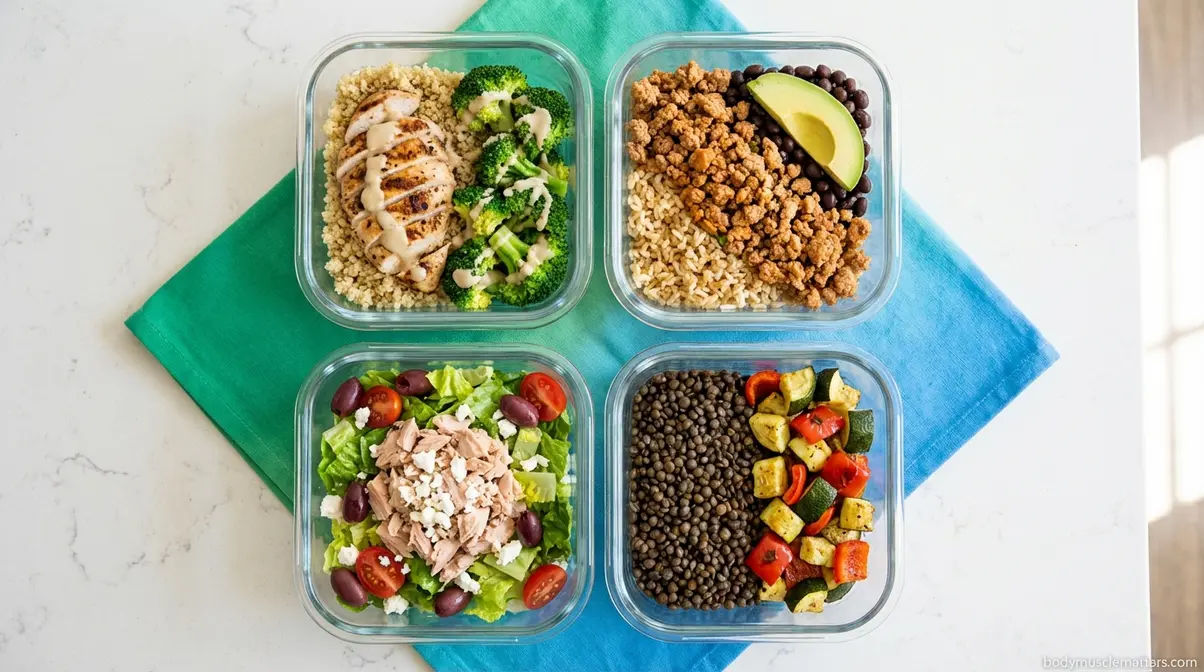
Meal-prepped lunches transform daily nutrition from a constant decision into an automated system. By batch-cooking components on a Sunday, you effortlessly secure 30 to 40 grams of protein for every workday lunch while entirely eliminating the temptation of low-protein fast food. The consistent pattern in fitness nutrition communities is clear: people who prep lunches on Sunday eat 40–60% more protein at lunch across the workweek than those who decide day-by-day.
Common challenges reported by beginners include boredom and food going bad before it gets eaten — both of which the strategies in this section directly address. Mastering bento box and bowl meal prep is the single most effective strategy for ensuring nutritional consistency across a chaotic workweek.
Meal-prepped lunches retain over 90% of their nutritional value after four days in the fridge — ensuring your Friday protein intake is as effective as Monday’s.
4 Meal-Prep Friendly High-Protein Bowls
These four bowls each hit 30g+ protein, stay fresh in the fridge for up to 4 days, and take less than 30 minutes to prep in bulk. Each follows the Protein Assembly Formula.
- Bowl 1: Chicken & Quinoa Power Bowl
- Protein Base: 4 oz grilled chicken breast (~28g)
- Fiber Anchor: ½ cup cooked quinoa (~4g) + ½ cup roasted broccoli
- Fat Boost: 1 tbsp tahini drizzle or olive oil
- Approx. Protein: ~32g | Prep time (4 servings): 25 minutes
- Bowl 2: Ground Turkey & Black Bean Rice Bowl
- Protein Base: 4 oz seasoned ground turkey (~28g)
- Fiber Anchor: ½ cup brown rice + ½ cup black beans (~7g)
- Fat Boost: sliced avocado + lime juice
- Approx. Protein: ~35g | Prep time (4 servings): 30 minutes
- Bowl 3: Greek Salad with Tuna & Feta
- Protein Base: 1 can albacore tuna (~26g)
- Fiber Anchor: romaine lettuce, cucumber, cherry tomatoes, kalamata olives
- Fat Boost: 1 oz crumbled feta (~4g) + olive oil and lemon dressing
- Approx. Protein: ~30g | Prep time (4 servings): 15 minutes
- Bowl 4: Lentil & Roasted Vegetable Bowl
- Protein Base: 1 cup cooked lentils (~18g)
- Fiber Anchor: roasted zucchini, bell pepper, and sweet potato
- Fat Boost: 2 tbsp Greek yogurt herbed dressing (~3g) + pumpkin seeds
- Approx. Protein: ~21–25g (add 1 hard-boiled egg to reach 30g)
“I toss roasted squash, salad greens, roasted chicken, cottage cheese, and homemade vinaigrette together. It’s so good!”
That quote captures what the best meal-prep bowls do: they feel assembled, not cooked. The components are prepped separately, stored separately, and combined fresh each day — which keeps textures better and prevents that “leftovers” feeling.
How to Build a High-Protein Bento Box
A bento box is a compartmented lunchbox — typically with 3–5 sections — that keeps foods separate until you eat them. It’s one of the best on-the-go formats for hitting macro goals because each compartment maps directly to a Protein Assembly Formula component.
Here’s a step-by-step bento box build for a 30g+ protein target:
- Section 1 — Protein Base: 3 oz rotisserie chicken strips OR 2 hard-boiled eggs OR 3 oz cubed firm tofu
- Section 2 — Fiber Anchor: ½ cup cooked edamame OR whole grain crackers OR ½ cup chickpea salad
- Section 3 — Fat Boost: 10–12 almonds OR 2 tbsp hummus OR ¼ avocado sliced
- Section 4 — Produce: Cherry tomatoes, cucumber spears, snap peas, or bell pepper strips
- Section 5 — Optional Extra: 1 single-serve cottage cheese cup (~12g) or Greek yogurt (for hitting 35–40g)
High protein bento box ideas work especially well for office lunches because nothing requires reheating. Pack it cold the night before and it’s ready to go.
Storage and Freshness Tips
Good meal prep only works if the food stays good. Here are the key storage rules for a protein-forward lunch rotation:
| Food Type | Fridge Storage | Notes |
|---|---|---|
| Cooked chicken / turkey | Up to 4 days | Store in airtight container; reheat to 165°F |
| Cooked grains (quinoa, rice) | Up to 5 days | Store dry; add sauce just before eating |
| Canned tuna (opened) | 1–2 days | Transfer to a sealed container after opening |
| Hard-boiled eggs (unpeeled) | Up to 1 week | Peel only when ready to eat |
| Cooked lentils / beans | Up to 5 days | Add vinaigrette to keep them from drying out |
| Assembled bowls (with dressing) | Up to 2 days | Keep dressing separate for days 3–4 |
Key rule: Keep dressings and sauces in a separate container and add them at the last minute. This single habit doubles how long your prepped bowls stay fresh and prevents the soggy-lunch problem that causes people to abandon meal prep entirely.
Step 3: Pick Your Format – Wraps, Bowls & More
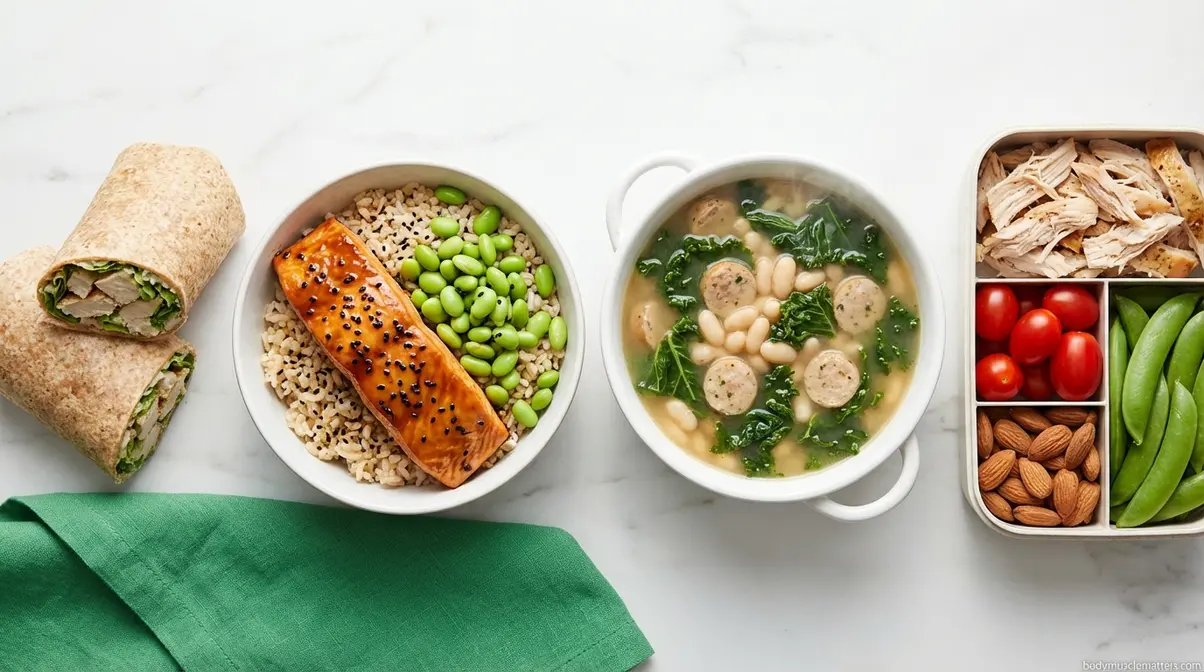
Different days call for different formats. Some lunches need to be portable; others benefit from a full bowl. Protein grain bowls, soups, wraps, and tuna-based lunches all reach 30g+ protein — the format is just a matter of what sounds good and what your kitchen supports. The Protein Assembly Formula applies equally well across all of them.
Embracing diverse formats like wraps and bowls ensures long-term dietary adherence by completely eliminating mid-week meal boredom.
Wrap and bowl formats provide unparalleled meal-prep flexibility for high-protein diets. Wraps act as the perfect portable Fiber Anchor, effectively securing 30 grams of protein in a convenient, handheld meal that requires zero reheating. Grain bowls serve a similar purpose for office environments, allowing users to stack a Protein Base like chicken or tuna over high-volume vegetables without compromising flavor. These specific structural formats ensure busy professionals maintain their macronutrient targets even during hectic workdays, eliminating the reliance on low-protein fast food alternatives.
High-Protein Wraps and Sandwiches
Wraps and sandwiches are the most familiar lunch format for most people, which makes them the easiest starting point for hitting macro goals without changing habits too dramatically.
- Wrap 1: Turkey Avocado Lavash Wrap
- High-fiber lavash flatbread + 4 oz deli turkey (~21g) + ½ avocado (Fat Boost) + romaine + mustard
- Approx. Protein: ~25–28g | Add Greek yogurt on the side for 35g+
- Wrap 2: Chicken Caesar Wrap
- Large whole wheat tortilla + 4 oz grilled chicken breast (~28g) + romaine + 1 tbsp Caesar dressing + 1 tbsp parmesan
- Approx. Protein: ~30–32g | Time to Table: 5 minutes
- Wrap 3: Tuna Salad Lettuce Wrap (Low-Carb Option)
- Large romaine or butter lettuce leaves (instead of wrap) + 1 can albacore tuna (~26g) + diced celery + Greek yogurt instead of mayo + lemon juice
- Approx. Protein: ~30g | Time to Table: 5 minutes
- Sandwich: High-Protein Egg Salad on Whole Grain
- 3 hard-boiled eggs (~18g) + 1 tbsp Greek yogurt (replaces mayo) + 1 tsp mustard + diced dill pickles on 2 slices whole grain bread
- Approx. Protein: ~22–24g | Add 2 oz turkey on the sandwich for 30g+
When selecting your wrap or bread, prioritize high-protein and high-fiber options like Ezekiel bread or low-carb tortillas. These can naturally add 4 to 8 extra grams of protein to your meal before you even add the Protein Base.
Across fitness nutrition communities, the consistent finding is that swapping standard mayonnaise for Greek yogurt in wraps and sandwiches typically adds 3–5 grams of protein per tablespoon while reducing calories — a specific, measurable upgrade that adds no preparation time. Swapping standard mayonnaise for Greek yogurt in wraps adds up to 5 grams of protein — a zero-effort upgrade that simultaneously reduces overall calories.
Grain Bowls, Soups & Cold Pasta
Bowl-based lunches are excellent for meal prep because they hold up well in the fridge and reheat in minutes. Cold pasta dishes add variety for people who find themselves bored with salads.
- Bowl 1: Teriyaki Salmon Rice Bowl
- 4 oz wild-caught salmon fillet (~25g) + ½ cup brown rice + steamed edamame + teriyaki glaze + sesame seeds
- Approx. Protein: ~35g | Time to Table: 15 minutes
- Bowl 2: Chicken Caesar Pasta Salad (Cold)
- 1 cup cooked chickpea pasta (~14g) + 3 oz grilled chicken (~21g) + romaine + parmesan + light Caesar dressing
- Approx. Protein: ~35g | Time to Table (prepped): 5 minutes
Chickpea pasta contributes approximately 14g of protein per cooked cup — about double the protein of standard wheat pasta — making it one of the more underused upgrades in budget-friendly meal prep.
- Soup 1: White Bean & Chicken Sausage Soup
- 1 cup cooked white beans (~17g) + 2 oz chicken sausage (~14g) + broth + kale + garlic
- Approx. Protein: ~31g | Prep time: 20 minutes | Stores 5 days
- Soup 2: Lentil and Turkey Sausage Minestrone
- 1 cup cooked lentils (~18g) + 2 oz turkey sausage (~14g) + bone broth base (~9g) + mixed vegetables.
- Approx. Protein: ~41g | Prep time: 25 minutes | Stores 4 days
- Bone broth represents an excellent liquid Protein Base for soups, effortlessly adding nearly 10g of protein per cup without changing the texture of the dish.
- Bowl 3: Greek Orzo & Turkey Meatball Bowl
- ½ cup cooked orzo + 4 oz turkey meatballs (~26g) + roasted cherry tomatoes + feta + cucumber
- Approx. Protein: ~30g | Time to Table: 20 minutes
Tuna-Based High-Protein Lunches
Canned tuna is one of the most protein-dense, budget-friendly pantry staples available — at roughly $1–3 per can depending on type. A standard 5 oz can of albacore tuna in water delivers approximately 26g of protein, while chunk light tuna provides around 20g (USDA FoodData Central, 2026). That’s a near-complete protein serving from a shelf-stable source.
The real advantage of tuna comes from what you pair it with. A standard tuna salad sandwich with mayonnaise delivers approximately 18–20g protein. Swap the mayo for Greek yogurt and add ½ cup white beans, and the same meal jumps to approximately 38–42g — a significant difference that no competing guide has surfaced as a specific comparison.
- Tuna Lunch 1: Mediterranean Tuna & White Bean Salad
- 1 can albacore tuna (~26g) + ½ cup white beans (~8g) + diced red onion + capers + olive oil + lemon
- Approx. Protein: ~34g | Time to Table: 5 minutes | Stores 2 days
- Tuna Lunch 2: Tuna-Stuffed Avocado
- Halve 1 avocado, remove pit, and fill each half with 2 oz tuna (~10g each) mixed with Greek yogurt and diced celery
- Approx. Protein: ~28g | Time to Table: 5 minutes
- Tuna Lunch 3: Tuna & Edamame Grain Bowl
- 1 can chunk light tuna (~20g) + ½ cup shelled edamame (~8g) + ½ cup quinoa + soy-ginger dressing
- Approx. Protein: ~32g | Time to Table: 10 minutes (pre-cooked quinoa)
- Tuna Lunch 4: Spicy Tuna Cucumber Boats
- 1 can chunk light tuna (~20g) + 2 tbsp Greek yogurt + sriracha + spooned into halved cucumbers.
- Approx. Protein: ~24g | Time to Table: 5 minutes
Step 4: Adjust Macros for Your Fitness Goal
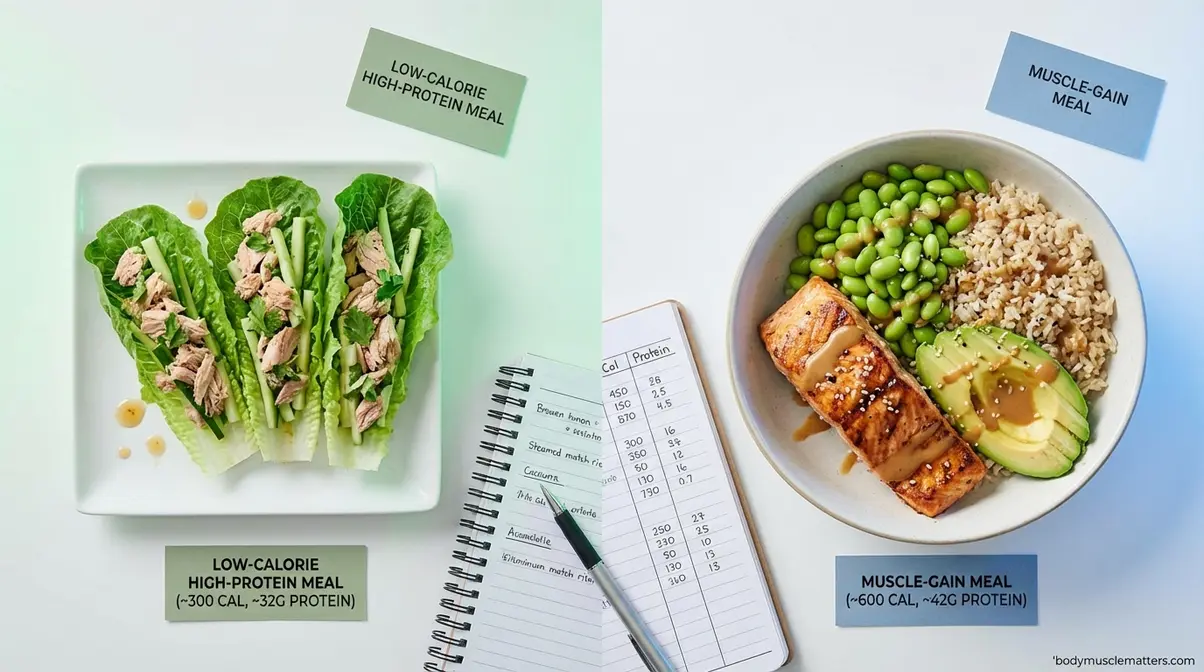
The Protein Assembly Formula gives you the framework — but the macros you target depend on what you’re trying to accomplish. Hitting 30g protein in 380 calories looks different from hitting 30g protein in 600 calories. Both can be right; the difference lies in your fitness goal.
Aligning your protein-to-calorie ratio with your specific fitness goal is the hidden mechanism that dictates whether you lose fat or build muscle.
3 Protein Lunches Under 400 Calories
These three options prove that high-protein lunches don’t have to be calorie-dense. Each delivers at least 30g protein within a tight calorie budget — useful if you’re managing weight while maintaining muscle.
- Option 1: Tuna & Cucumber Lettuce Wraps
- 1 can chunk light tuna (~20g) + 2 hard-boiled eggs (~12g) + sliced cucumber + mustard in large romaine leaves
- ~32g protein | ~300 calories | Time to Table: 5 minutes
- Option 2: Non-Fat Cottage Cheese & Tomato Bowl
- 1 cup non-fat cottage cheese (~25g) + sliced tomatoes + 1 hard-boiled egg (~6g) + fresh basil + a drizzle of balsamic
- ~31g protein | ~280 calories | Time to Table: 4 minutes
- Option 3: Turkey & Spinach Egg White Wrap
- 2 oz deli turkey (~11g) + 3 egg whites (~11g, scrambled) + 1 cup spinach + salsa in a low-carb whole wheat wrap (~8g)
- ~30g protein | ~350 calories | Time to Table: 8 minutes
Lunches That Support Lean Muscle Gain
For lean muscle gain, the goal shifts from calorie restriction to protein density plus adequate total fuel. You still want clean, whole-food sources — but the servings get slightly larger and you add more calorie-dense elements like quinoa, brown rice, healthy fats, and starchy vegetables. Lean muscle gain requires strategic calorie surpluses alongside high protein intake — without adequate carbohydrates, your body burns valuable protein for energy instead of building muscle.
- Option 1: Double-Protein Chicken Quinoa Bowl
- 5 oz chicken breast (~35g) + ¾ cup quinoa (~6g) + roasted sweet potato + 2 tbsp tahini dressing
- ~41g protein | ~580 calories
- Option 2: Salmon, Edamame & Brown Rice Bowl
- 4 oz salmon (~25g) + ½ cup brown rice + 1 cup edamame (~17g) + avocado + miso dressing
- ~42g protein | ~600 calories
- Option 3: Ground Turkey & Lentil Power Bowl
- 4 oz ground turkey (~28g) + ½ cup lentils (~9g) + roasted broccoli + olive oil + garlic
- ~37g protein | ~520 calories
Your body requires an adequate caloric surplus to synthesize new muscle tissue effectively. Adding complex carbohydrates like brown rice, quinoa, or sweet potatoes not only provides the necessary energy for heavy lifting but also creates an insulin response that shuttles amino acids directly into your muscle cells. Without these supporting carbohydrates and fats, your body may convert dietary protein into baseline energy rather than using it for muscle repair.
Across nutrition communities, the consistent finding is that muscle-gain lunches benefit most from combining a fast-digesting complete protein (chicken, turkey, fish) with a slower-digesting plant protein (lentils, beans, edamame) — this combination sustains amino acid availability for 3–4 hours post-meal rather than 1–2 hours from a single source alone.
The Protein-to-Calorie Ratio
The protein-to-calorie ratio (also written as g protein per 100 calories) is a simple measure of how “protein-efficient” a food is. The higher the ratio, the more protein you get per calorie consumed. This matters most when you’re trying to hit 30–40g protein without blowing a calorie target.
| Food | Protein per 100 Calories (approx.) |
|---|---|
| Canned tuna (in water) | ~22g |
| Non-fat cottage cheese | ~17g |
| Non-fat Greek yogurt | ~16g |
| Chicken breast (cooked) | ~18g |
| Lentils (cooked) | ~8g |
| Whole egg | ~8g |
| Cheddar cheese | ~6g |
| Almonds | ~4g |
Foods at the top of this table are your best allies when calorie control matters. Foods toward the bottom can still contribute to your total — but they work better as Fat Boost components than as your primary protein source.
Step 5: High-Protein Lunches for Special Diets
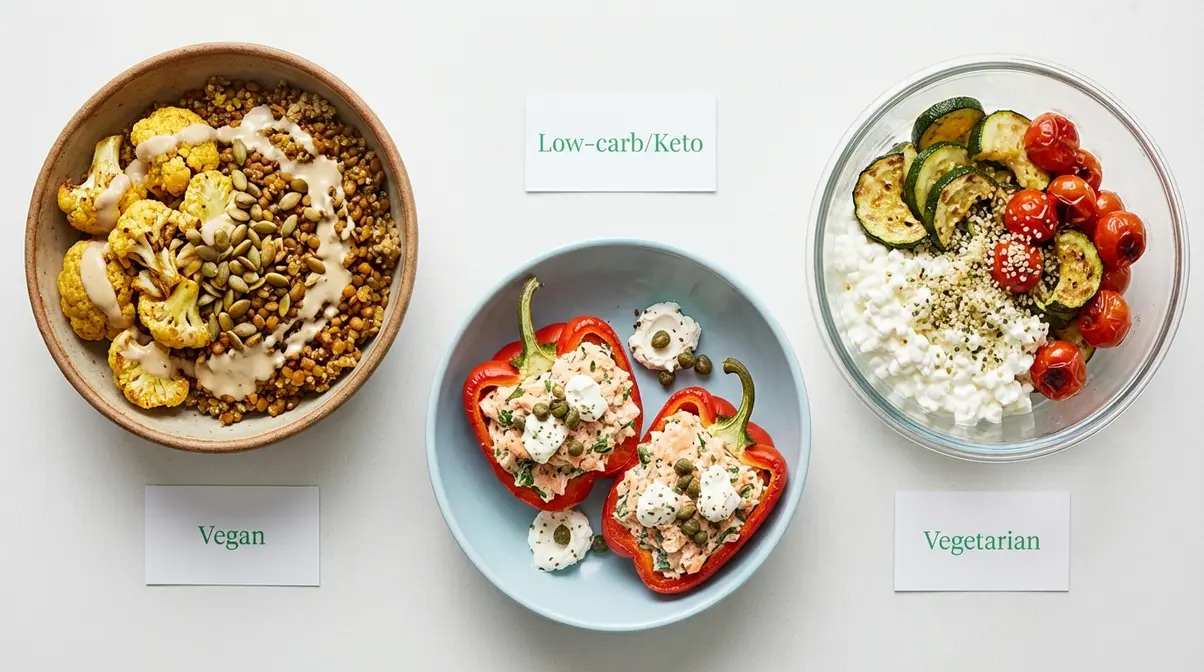
Healthy high protein lunch ideas don’t require meat. They don’t require dairy. And they don’t require carbs if you prefer to avoid them. The Protein Assembly Formula adapts cleanly to plant-based, low-carb, and gut-health-focused eating patterns — you simply swap components within each category.
Integrating high-fiber plant proteins transforms an average healthy lunch into a powerful tool for sustained energy and optimal gut health.
Vegan & Vegetarian Protein Lunches
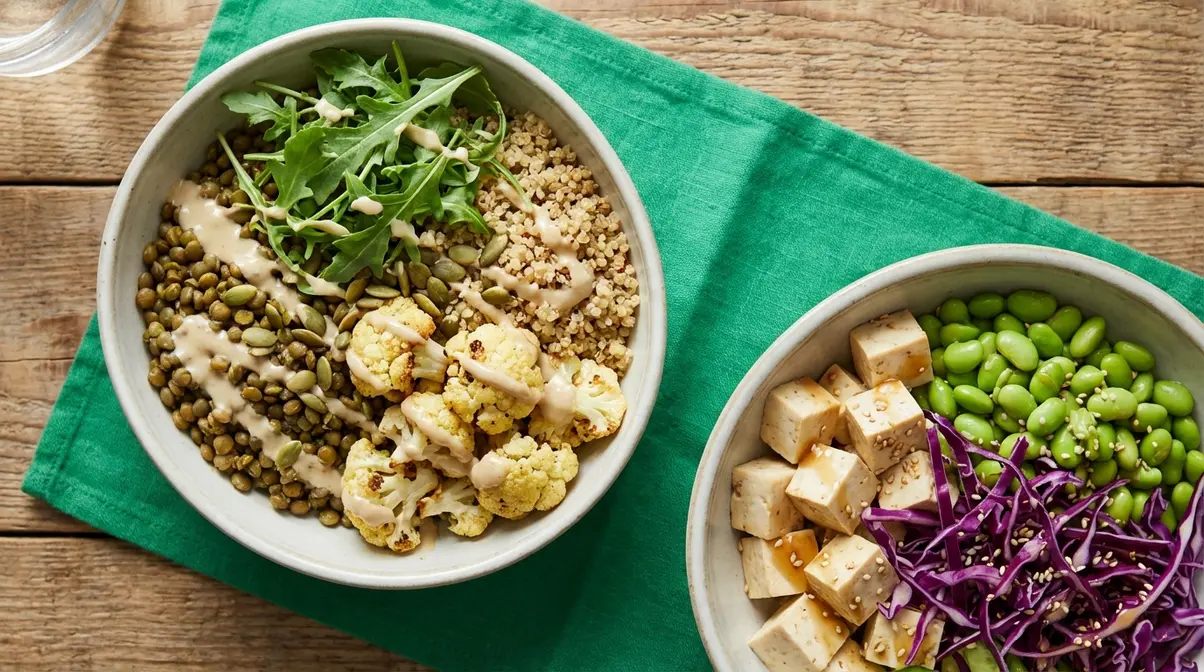
One of the most persistent myths in beginner nutrition is that plant proteins can’t match animal proteins at lunch. The reality is more nuanced: whole plant sources like lentils (~18g/cup) and edamame (~17g/cup) come close to chicken breast per serving — but they’re incomplete proteins (meaning they lack one or more essential amino acids individually). The fix is simple: combine two complementary plant proteins at the same meal, and the amino acid profile becomes complete.
- Vegan Lunch 1: Spiced Lentil & Quinoa Bowl
- 1 cup cooked green lentils (~18g) + ½ cup quinoa (~4g, a complete protein grain) + roasted cauliflower + tahini-lemon dressing + pumpkin seeds
- Approx. Protein: ~25–27g | Time to Table: 15 minutes (prepped) | Budget-friendly under $3 per serving
Quinoa is one of the few plant foods that qualifies as a complete protein (meaning it contains all nine essential amino acids) — making it a strategic pairing with lentils or chickpeas.
- Vegan Lunch 2: Silken Tofu & Edamame Protein Jar
- ½ cup firm tofu (~10g), marinated in soy sauce and sesame oil + 1 cup edamame (~17g) + shredded purple cabbage + rice vinegar + sesame seeds
- Approx. Protein: ~27g | Time to Table: 10 minutes | Gut-friendly high fiber
- Vegetarian Lunch 1: Cottage Cheese & Roasted Vegetable Bowl (Lacto-Vegetarian)
- 1 cup cottage cheese (~25g) + roasted zucchini, bell pepper, and cherry tomatoes + 1 tbsp hemp seeds (~3g) + balsamic drizzle
- Approx. Protein: ~28g | Time to Table: 20 minutes roasting + 5 min assembly
- Vegetarian Lunch 2: Greek Yogurt Chickpea Salad Wrap
- ½ cup chickpeas (~8g) + ½ cup Greek yogurt (~9g, used as the dressing base) + 2 hard-boiled eggs (~12g) + diced cucumber + whole grain wrap
- Approx. Protein: ~29g | Time to Table: 10 minutes
Low-Carb & Keto Protein Lunches
Low-carb and keto-friendly protein lunches swap the Fiber Anchor component for non-starchy vegetables — leafy greens, cucumber, zucchini, bell peppers — instead of grains or beans. The protein count stays identical; only the carbohydrate source changes.
- Low-Carb Lunch 1: BLT Lettuce Wrap with Turkey & Avocado
- Large butter lettuce leaves (replace wrap) + 4 oz deli turkey (~21g) + 2 strips turkey bacon (~6g) + avocado slices + tomato + mustard
- Approx. Protein: ~27–30g | Net Carbs: ~4g | Time to Table: 7 minutes
- Low-Carb Lunch 2: Egg Salad Cucumber Boats
- 3 hard-boiled eggs (~18g) mixed with 2 tbsp Greek yogurt + mustard + dill, spooned into halved cucumbers (instead of bread)
- Approx. Protein: ~22g | Add 2 oz smoked salmon on the side for 30g+
- Keto Lunch: Salmon & Cream Cheese Stuffed Peppers
- 4 oz wild salmon (~25g) + 2 tbsp cream cheese (~2g) + capers + lemon, stuffed into halved bell peppers
- Approx. Protein: ~27g | Net Carbs: ~6g | Time to Table: 10 minutes
High-Fiber & Protein Combos
The dual benefit of combining high protein with high fiber is significant for beginners focused on gut health: protein supports muscle repair and satiety, while fiber feeds beneficial gut bacteria and slows glucose absorption — which means more stable energy and fewer afternoon energy crashes. Research consistently links both higher protein and higher fiber intake with better blood sugar regulation and reduced mid-afternoon hunger (Experience Life, 2026).
- Gut-Healthy Combo 1: Warm Lentil & Roasted Squash Salad
- 1 cup cooked puy (green) lentils (~18g protein, ~16g fiber) + roasted butternut squash + arugula + walnuts + apple cider vinaigrette
- Approx. Protein: ~20g | Fiber: ~20g | Time to Table: 30 minutes (squash roasting)
- Add 1 cup cottage cheese (~25g) on the side to hit 30g+ protein total
- Gut-Healthy Combo 2: Black Bean & Egg Burrito Bowl
- 1 cup black beans (~15g protein, ~15g fiber) + 2 scrambled eggs (~12g) + salsa + avocado + whole grain base optional
- Approx. Protein: ~27g | Fiber: ~17g | Time to Table: 10 minutes
- Gut-Healthy Combo 3: Chickpea & Greek Yogurt Power Salad
- ½ cup chickpeas (~8g protein, ~6g fiber) + ½ cup Greek yogurt base dressing (~9g) + spinach + roasted red pepper + lemon + 1 tbsp flaxseed (~1g fiber bonus)
- Approx. Protein: ~17g — pair with 2 oz canned salmon for 30g+ total
Combining half a cup of chickpeas with Greek yogurt yields 17 grams of protein — creating a complete amino acid profile that powerfully stabilizes afternoon blood sugar. High-fiber, high-protein lunch combinations represent the most underexplored category in beginner nutrition guides. None of the top five competitor articles address the gut-health angle specifically — leaving readers without this practically important reason to choose beans and lentils alongside their protein source.
Common Mistakes That Sabotage Your Protein Goals
Even with the right intentions, a few consistent patterns prevent people from hitting their lunch protein targets. Recognizing these early saves weeks of frustration.
Common Pitfalls
Pitfall 1: Treating eggs as a complete protein lunch. Two eggs deliver approximately 12g protein — less than half of a 30g target. This is the single most common beginner miscalculation. Always pair eggs with a second protein source (cottage cheese, Greek yogurt, tuna) to reach an adequate total.
Pitfall 2: Using mayo-based dressings instead of Greek yogurt. Standard mayonnaise adds calories with minimal protein. Greek yogurt provides roughly 9g protein per half-cup while performing the same creamy function in wraps, egg salads, and tuna mixtures.
Pitfall 3: Counting plant proteins without checking completeness. Relying on a single plant protein source (only chickpeas, only rice) often results in an incomplete amino acid profile. Combine at least two plant sources — lentils + quinoa, beans + eggs, tofu + edamame — to ensure full coverage.
Pitfall 4: Skipping the Fiber Anchor. High protein without fiber leads to faster gastric emptying — which means hunger returns sooner. Every lunch should include a Fiber Anchor component to maintain satiety for 3–4 hours.
When to Choose Alternatives
If you’re consistently under 20g protein at lunch despite using these recipes, consider tracking with a free app (MyFitnessPal or Cronometer) for 5–7 days to identify where the gap actually occurs. Many people find the gap is at breakfast, not lunch.
If meal prep causes food boredom by day 3, switch to a “component prep” strategy instead of assembling full bowls: prep proteins, grains, and vegetables separately, then combine differently each day.
If plant-based options aren’t reaching 30g, it’s worth working with a Registered Dietitian who specializes in plant-based nutrition. The combinations are achievable, but the threshold requires planning that benefits from professional guidance.
When to Seek Expert Help
Consult a Registered Dietitian if you have: kidney disease or a history of kidney stones (high protein diets may need modification); a diagnosed eating disorder; pregnancy or breastfeeding (protein needs change significantly); or if you’re taking medications affected by high-potassium plant foods. The guidance in this article is educational — not a substitute for personalized medical nutrition therapy.
Frequently Asked Questions
What are some good high protein lunches?
Good high-protein lunches combine a Protein Base with a second supporting source to hit 25–35g total. Strong options include canned tuna mixed with white beans and olive oil (~34g, under 5 minutes), grilled chicken quinoa bowls (~32g), and cottage cheese with hard-boiled eggs and vegetables (~31g). According to 2026 guidance from the USDA Dietary Guidelines, most adults benefit from 25–35 grams of protein per meal for sustained energy and muscle support. The best choices are those you’ll actually prepare — so pick two or three formats from this guide and rotate them weekly.
How to get 30g protein for lunch?
Hitting 30 grams of protein at lunch requires pairing two protein sources, not relying on one. A single food rarely reaches 30g at a practical serving size. Three reliable combinations: (1) 1 can albacore tuna (~26g) + ½ cup white beans (~8g); (2) 4 oz chicken breast (~28g) + ½ cup Greek yogurt on the side (~8g); (3) 1 cup cottage cheese (~25g) + 2 hard-boiled eggs (~12g). Any of these hits 30g before you add vegetables, grains, or a Fat Boost component. Experience Life provides a helpful visual guide to what 30g looks like across food sources.
What is a 3-ingredient high protein lunch?
A 3-ingredient high-protein lunch uses one Protein Base, one Fiber Anchor, and one Fat Boost to hit 25–35g protein in minutes. The most efficient example: canned tuna (Protein Base) + white beans (Fiber Anchor) + lemon juice and olive oil (Fat Boost) = approximately 34g protein in 3 minutes with no cooking. Other strong 3-ingredient combinations include rotisserie chicken + Greek yogurt dip + cucumber (~38g) and deli turkey roll-ups + string cheese + cherry tomatoes (~26g). The Protein Assembly Formula in this guide turns any three-ingredient combination into a reliable protein target.
How to get 40g protein in one meal?
Reaching 40 grams of protein in one meal typically requires two substantial protein sources combined at the same serving. Proven combinations: 1 can albacore tuna (~26g) + ½ cup white beans (~8g) + 1 hard-boiled egg (~6g) = ~40g total; or 5 oz cooked chicken breast (~35g) + ½ cup Greek yogurt on the side (~8g) = ~43g. A Double-Protein Chicken Quinoa Bowl (5 oz chicken + ¾ cup quinoa + tahini) can reach 41g. The key is stacking sources strategically rather than eating more of a single food.
Are 2 eggs enough protein for lunch?
No — 2 large eggs provide approximately 12 grams of protein, which is less than half of the 25–30g recommended per meal by health experts. Two eggs make an excellent starting point, but they need a supporting protein source to function as a complete high-protein lunch. Pair 2 eggs with ½ cup cottage cheese (+12g = ~24g total) or add 2 oz deli turkey (+11g = ~23g) to get closer to 30g. For a full 30g+ meal, use 3 eggs (~18g) plus cottage cheese or Greek yogurt stirred in while cooking.
What lunch food has a lot of protein?
The highest-protein lunch foods per realistic serving are: albacore canned tuna (~26g per can), cooked chicken breast (~28–30g per 4 oz), non-fat cottage cheese (~25g per cup), and non-fat Greek yogurt (~17g per cup). Plant-based options with strong protein include cooked lentils (~18g per cup), edamame (~17g per cup), and white beans (~17g per cup). Budget-friendly pick: canned tuna delivers more protein per dollar than almost any other lunch protein, at roughly $1–3 per can depending on type. Combine any two from this list and you’ll consistently hit 30g+ protein at lunch.
Build Your Lunch System – Starting Today
For health-conscious adults trying to hit their macro goals, a reliable high-protein lunch system makes the difference between hitting protein targets and falling 20 grams short by 3 p.m. The Protein Assembly Formula — Protein Base + Fiber Anchor + Fat Boost — delivers 30–40g protein at lunch without requiring cooking expertise, expensive ingredients, or more than 10 minutes of active time. Pair two protein sources at every lunch, and the target becomes achievable rather than accidental.
The Protein Assembly Formula is the framework that makes all 45 recipes in this guide work. It’s why a 3-ingredient no-cook tuna bowl and a meal-prepped quinoa bowl both hit 30g protein — they follow the same structural logic, just with different components. Once you internalize the formula, you stop needing recipes entirely and start building from whatever is in your fridge.
Start today by picking one recipe from Step 1 — the one that matches what you already have at home — and assemble it right now. Don’t wait until you’ve meal prepped, stocked up, or perfected your macro tracking. One lunch at 30g protein is more valuable than a plan you haven’t started. Trial the Protein Assembly Formula for five lunches this week, track what you build, and notice how much more consistent your afternoon energy becomes. Consult a Registered Dietitian if you want a personalized protein target that accounts for your specific activity level, goals, and health history.